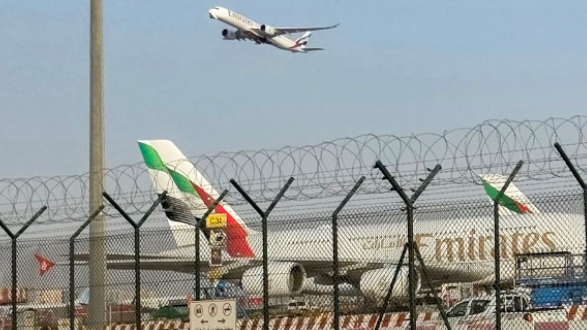
Rising tensions in the Middle East escalated on Wednesday after drones crashed near Dubai International Airport, leaving four people injured and triggering fresh concerns over aviation safety and regional security.
Authorities said the drones fell close to the busy airport while Iran intensified attacks across the Gulf, targeting strategic oil and shipping routes in response to earlier strikes by the United States and Israel that sparked the ongoing Middle East conflict.
The attacks also affected maritime traffic in the Strait of Hormuz, one of the world’s most critical energy corridors through which nearly 20 percent of global oil supplies normally pass.
According to the United Kingdom Maritime Trade Operations, two commercial vessels were struck by unidentified projectiles off the coast of the United Arab Emirates.
One incident occurred near Dubai while another was reported off Ras Al Khaimah.
A third ship was also hit in waters near Oman, sparking a fire that was later brought under control.
Military tensions spread further across the Gulf as Saudi Arabia reported intercepting drones targeting the strategic Shaybah oil field, a vital part of the kingdom’s energy infrastructure.
The Saudi government also confirmed that seven ballistic missiles aimed at its eastern region and Prince Sultan Air Base were successfully intercepted.
The conflict has increasingly targeted oil facilities across the region. In recent days, attacks were reported on Saudi Aramco’s massive Ras Tanura Refinery, one of the largest refining complexes in the Middle East.
Similarly, the Ruwais Refinery, another major global refining hub, was also targeted, raising fears of prolonged disruptions to energy supplies.
The situation has already forced QatarEnergy, one of the world’s leading producers of liquefied natural gas, to temporarily suspend production and declare force majeure, citing security risks.
Energy producers in Kuwait have issued similar warnings that ongoing hostilities could affect export commitments.
Analysts warn that Iran’s strategy appears aimed at disrupting Gulf energy infrastructure and tightening pressure on the Strait of Hormuz, potentially inflicting severe shocks on global oil markets and shipping routes.
The escalating attacks have heightened fears of wider economic fallout as energy prices continue to swing amid uncertainty in one of the world’s most vital oil-producing regions.