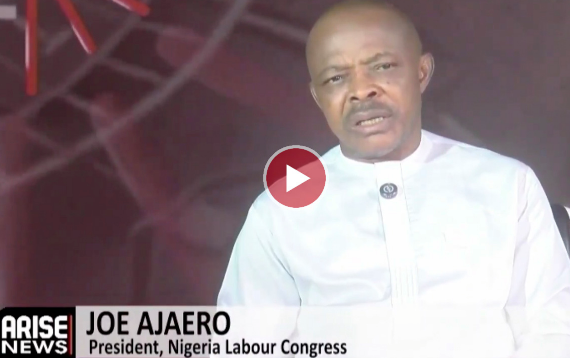
The President of the Nigeria Labour Congress (NLC), Joe Ajaero, has raised concerns over Nigeria’s vulnerability to sudden international economic crises, warning that the country currently has no mechanisms to cushion citizens from the impact of global shocks.
In an interview with Arise News on Monday, Ajaero explained that recent disruptions in the global oil market demonstrated how quickly ordinary Nigerians feel the effects of international instability.
“The current crisis between the three nations has just exposed us as a country without a shock absorber. If there is a crisis in the global oil market today, Nigerians will feel it immediately,” he said.
Ajaero emphasised the urgent need for both public and private refineries to operate efficiently within Nigeria.
He argued that local refining is essential to protect the country from sudden global oil price surges.
The NLC President suggested that even small-scale, locally run refineries in the Niger Delta could be viable if deregulated.
“Refineries can work here. Look at the Dangote Refinery, it is proof that local refining is possible.
”Even one-man operations can succeed,” he said.
The NLC chief also criticised current government tax policies, particularly frequent deductions on cashless transactions.
According to him, such measures disproportionately affect low-income earners and undermine intended tax relief initiatives.
“Every 10,000 Naira you transfer is taxed. Even workers earning minimum wage who send money to their families are heavily burdened. Who came up with this policy?” he questioned.
Ajaero stressed that cash transfers to citizens should be transparent and monitored by community leaders to ensure funds reach those most in need.
He called for local oversight to guarantee aid is distributed fairly and efficiently.
The NLC President explained that wage awards are intended as interim measures to offset rising living costs, not permanent salary increases.
He highlighted that some government workers have still not received the full 35,000 Naira wage award introduced two years ago.
“These awards help workers cope with unexpected inflation. They are not part of regular salaries,” he noted.
Ajaero reaffirmed the union’s preference for dialogue with government authorities before resorting to strikes.
He cited a December protest that followed six months of unanswered letters to the President as an example of the NLC’s efforts to engage constructively.
“Our first step is always to seek dialogue. Strikes are a last resort,” he said.