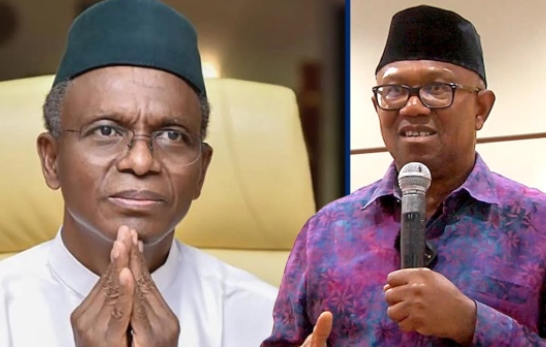
A former presidential candidate of the Labour Party, Peter Obi, has criticised the arrest and continued detention of former Kaduna State governor, Nasir El-Rufai, describing the development as politically motivated.
Obi made the remarks on Sunday during a meeting with stakeholders of the African Democratic Congress in Kaduna, where he expressed concern over what he termed a threat to democratic principles and the rule of law.
According to him, the handling of El-Rufai’s case by the Independent Corrupt Practices and Other Related Offences Commission raises serious legal and ethical questions, particularly regarding the treatment of individuals who have not been convicted by a court of law.
Obi argued that every citizen is entitled to dignity and fair treatment under the law, insisting that due process must be followed at all times.
He questioned the circumstances surrounding El-Rufai’s detention, noting that the former governor had returned to the country voluntarily and should not be treated as a fugitive.
El-Rufai, who served as governor of Kaduna State, has been in ICPC custody since February 18 following his transfer from the Economic and Financial Crimes Commission.
Authorities are investigating allegations of money laundering and abuse of office.
In addition, the Department of State Services has filed charges bordering on cybercrime against him, with a court hearing scheduled for April 23, 2026.
However, the former governor has challenged his detention in court, filing suits against both the DSS and ICPC.
He accuses the agencies of unlawful detention, abuse of power, and violations of court procedures.
His legal team, led by counsel Ubong Esop Akpan, has also formally petitioned the ICPC leadership, alleging misrepresentation and disregard for due process in the handling of the case.
Family members of El-Rufai have equally called for his release, maintaining that his continued detention is unjustified and infringes on his fundamental rights.
The case continues to generate public debate, with concerns being raised in political and legal circles about its implications for governance, accountability, and the protection of civil liberties in Nigeria.