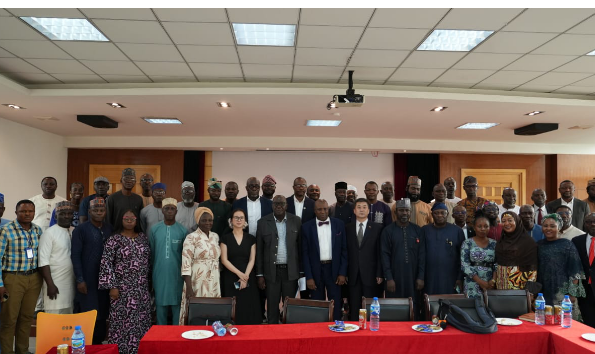
Nigeria and China have signalled a stronger alignment in governance thinking and development strategy following a high-level policy dialogue in Abuja that explored lessons from China’s development model and their relevance to Africa’s modernization agenda.
The event, held at the China Chamber of Commerce in Nigeria and organised by the Centre for China Studies, brought together diplomats, academics and policy experts to examine China’s governance experience and its implications for Nigeria–China cooperation.
Held under the theme, “The Governance of China and Knowledge Sharing in Nigeria–China Cooperation: Implications for Mutual Learning,” the dialogue focused on governance innovation, poverty reduction, economic transformation and sustainable development.
Speaking at the event, Chinese Embassy Counsellor, Wang Jun, described the The Governance of China series authored by Chinese President Xi Jinping as a comprehensive presentation of China’s governance philosophy and policy experience.
According to Wang, the publications provide detailed insights into key areas of China’s development journey, including poverty alleviation, ecological sustainability, modernization and long-term national planning.
He highlighted China’s success in lifting hundreds of millions of citizens out of poverty, describing the achievement as one of the most significant examples of people-centred development in modern history.
Wang said the experience offers valuable lessons for countries seeking inclusive growth and broad-based economic development.
The diplomat also pointed to China’s environmental governance framework, noting that the principle that “lucid waters and lush mountains are invaluable assets” reflects the country’s efforts to balance economic advancement with ecological protection.
While stressing China’s willingness to share its development experience with African countries, Wang maintained that every nation must pursue a development path that reflects its unique realities and national circumstances.
He added that cooperation between China and African countries continues to expand under a shared commitment to development, partnership and a common future.
In a keynote presentation, Provost of the Anti-Corruption Academy of Nigeria and Director of the Centre for Contemporary China–Africa Research, Professor Sheriff Ghali Ibrahim, urged participants to approach the discussions with an open and analytical mindset.
According to him, governance challenges cannot be solved through a single perspective, making comparative learning and intellectual exchange essential for policy innovation.
Adopting what he described as a Socratic approach, Ibrahim argued that meaningful progress often emerges from questioning assumptions and examining practical experiences from different societies.
He explained that The Governance of China is a collection of speeches and policy writings by President Xi Jinping, organised around themes such as reform, modernisation, the rule of law, ecological sustainability and national rejuvenation.
The scholar traced the evolution of the publication series, noting that earlier volumes concentrated on reform and economic opening, while subsequent editions addressed issues including poverty reduction, pandemic management and China’s broader modernisation drive.
He also referenced Selected Readings of Xi Jinping, which he said offers additional insight into the country’s long-term governance priorities and development objectives.
Highlighting the principles underpinning Chinese modernisation, Ibrahim identified people-centred development, common prosperity, balanced material and cultural advancement, environmental sustainability and peaceful development as central pillars.
He noted that China’s modernisation strategy differs from traditional models associated with colonial expansion, emphasizing cooperation, domestic transformation and shared development instead.
On the Belt and Road Initiative, Ibrahim argued that the programme extends far beyond physical infrastructure projects.
According to him, the initiative encompasses policy coordination, trade facilitation, financial integration, digital connectivity and cultural exchanges, making it a broader framework for international cooperation and development partnerships.
He further discussed China’s concept of holistic national security, which integrates political stability, economic growth, social cohesion and environmental sustainability into a single governance framework.
Such an approach, he said, recognises that sustainable development can only be achieved when security and stability are effectively balanced with economic progress.
Speaking on bilateral relations, Ibrahim observed that ties between Nigeria and China have evolved into a comprehensive strategic partnership, with collaboration expanding across several critical sectors.
These areas, he noted, include infrastructure development, nuclear energy, media cooperation, technology transfer and human capacity development.
He disclosed that trade between both countries has surpassed $28 billion, reflecting the growing scale of economic engagement and commercial cooperation.
The professor also drew attention to China’s tariff reductions on selected African exports, describing the move as an opportunity for African countries to increase industrial production and value addition rather than relying heavily on raw material exports.
According to him, stronger industrial processing capabilities would enable African economies to derive greater value from their natural resources while improving competitiveness in international markets.
Participants at the dialogue collectively called for deeper knowledge sharing, stronger policy collaboration and expanded intellectual engagement between both countries.
They stressed that sustained cooperation in governance innovation, modernisation strategies and sustainable development could strengthen bilateral relations and contribute to broader development goals across Africa.
The meeting concluded with a renewed commitment to fostering mutual learning and expanding opportunities for collaboration between Nigerian and Chinese institutions in the years ahead.
Nigeria and China have signalled a stronger alignment in governance thinking and development strategy following a high-level policy dialogue in Abuja that explored lessons from China’s development model and their relevance to Africa’s modernization agenda.
The event, held at the China Chamber of Commerce in Nigeria and organised by the Centre for China Studies, brought together diplomats, academics and policy experts to examine China’s governance experience and its implications for Nigeria–China cooperation.
Held under the theme, “The Governance of China and Knowledge Sharing in Nigeria–China Cooperation: Implications for Mutual Learning,” the dialogue focused on governance innovation, poverty reduction, economic transformation and sustainable development.
Speaking at the event, Chinese Embassy Counsellor, Wang Jun, described the The Governance of China series authored by Chinese President Xi Jinping as a comprehensive presentation of China’s governance philosophy and policy experience.
According to Wang, the publications provide detailed insights into key areas of China’s development journey, including poverty alleviation, ecological sustainability, modernization and long-term national planning.
He highlighted China’s success in lifting hundreds of millions of citizens out of poverty, describing the achievement as one of the most significant examples of people-centred development in modern history.
Wang said the experience offers valuable lessons for countries seeking inclusive growth and broad-based economic development.
The diplomat also pointed to China’s environmental governance framework, noting that the principle that “lucid waters and lush mountains are invaluable assets” reflects the country’s efforts to balance economic advancement with ecological protection.
While stressing China’s willingness to share its development experience with African countries, Wang maintained that every nation must pursue a development path that reflects its unique realities and national circumstances.
He added that cooperation between China and African countries continues to expand under a shared commitment to development, partnership and a common future.
In a keynote presentation, Provost of the Anti-Corruption Academy of Nigeria and Director of the Centre for Contemporary China–Africa Research, Professor Sheriff Ghali Ibrahim, urged participants to approach the discussions with an open and analytical mindset.
According to him, governance challenges cannot be solved through a single perspective, making comparative learning and intellectual exchange essential for policy innovation.
Adopting what he described as a Socratic approach, Ibrahim argued that meaningful progress often emerges from questioning assumptions and examining practical experiences from different societies.
He explained that The Governance of China is a collection of speeches and policy writings by President Xi Jinping, organised around themes such as reform, modernisation, the rule of law, ecological sustainability and national rejuvenation.
The scholar traced the evolution of the publication series, noting that earlier volumes concentrated on reform and economic opening, while subsequent editions addressed issues including poverty reduction, pandemic management and China’s broader modernisation drive.
He also referenced Selected Readings of Xi Jinping, which he said offers additional insight into the country’s long-term governance priorities and development objectives.
Highlighting the principles underpinning Chinese modernisation, Ibrahim identified people-centred development, common prosperity, balanced material and cultural advancement, environmental sustainability and peaceful development as central pillars.
He noted that China’s modernisation strategy differs from traditional models associated with colonial expansion, emphasizing cooperation, domestic transformation and shared development instead.
On the Belt and Road Initiative, Ibrahim argued that the programme extends far beyond physical infrastructure projects.
According to him, the initiative encompasses policy coordination, trade facilitation, financial integration, digital connectivity and cultural exchanges, making it a broader framework for international cooperation and development partnerships.
He further discussed China’s concept of holistic national security, which integrates political stability, economic growth, social cohesion and environmental sustainability into a single governance framework.
Such an approach, he said, recognises that sustainable development can only be achieved when security and stability are effectively balanced with economic progress.
Speaking on bilateral relations, Ibrahim observed that ties between Nigeria and China have evolved into a comprehensive strategic partnership, with collaboration expanding across several critical sectors.
These areas, he noted, include infrastructure development, nuclear energy, media cooperation, technology transfer and human capacity development.
He disclosed that trade between both countries has surpassed $28 billion, reflecting the growing scale of economic engagement and commercial cooperation.
The professor also drew attention to China’s tariff reductions on selected African exports, describing the move as an opportunity for African countries to increase industrial production and value addition rather than relying heavily on raw material exports.
According to him, stronger industrial processing capabilities would enable African economies to derive greater value from their natural resources while improving competitiveness in international markets.
Participants at the dialogue collectively called for deeper knowledge sharing, stronger policy collaboration and expanded intellectual engagement between both countries.
They stressed that sustained cooperation in governance innovation, modernisation strategies and sustainable development could strengthen bilateral relations and contribute to broader development goals across Africa.
The meeting concluded with a renewed commitment to fostering mutual learning and expanding opportunities for collaboration between Nigerian and Chinese institutions in the years ahead.