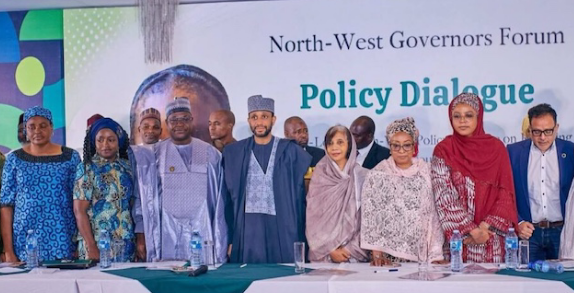
Governors of Nigeria’s North-West states have agreed on a comprehensive package of reforms aimed at reducing child poverty and expanding social protection programmes across the region, following a high-level policy dialogue in Kano.
The two-day meeting, organised by the North-West Governors’ Forum in collaboration with the Office of the Vice President, the European Union and UNICEF, brought together senior government officials, development partners, traditional rulers, youth groups and private sector representatives to address growing concerns over poverty and human development challenges in the region.
The gathering is being viewed as one of the most coordinated regional efforts in recent years to confront multidimensional poverty affecting millions of residents, particularly children and women.
Home to an estimated 60 million people, the North-West continues to face significant challenges in education, healthcare, nutrition, water supply, sanitation and household income security.
Participants noted that in several parts of the region, more than half of school-age children remain out of school, highlighting the scale of the crisis and the need for urgent intervention.
At the end of the dialogue, the governors adopted a joint communiqué outlining a series of commitments designed to improve child welfare, strengthen social protection systems and enhance access to essential public services.
The resolutions include plans to expand child-focused social intervention programmes, improve the delivery of healthcare and education services, and increase domestic funding for poverty reduction initiatives across the region.
The governors also endorsed a regional monitoring and accountability framework intended to track progress, evaluate implementation and ensure that agreed reforms translate into measurable outcomes.
Chairman of the North-West Governors’ Forum and Governor of Katsina State, Dikko Umaru Radda, represented by his deputy at the event, described the outcome of the meeting as a significant step towards practical action.
According to him, the region has moved beyond policy discussions and now possesses a clear roadmap for improving human capital development, especially among children and vulnerable populations.
He noted that the governors had collectively agreed on defined priorities and responsibilities that would guide future investments and policy interventions across the seven states of the region.
Vice President Kashim Shettima, who addressed participants at the forum, emphasised that the success of the initiative should ultimately be measured by improvements in the daily lives of ordinary citizens.
He reaffirmed the commitment of the Federal Government to support state-led efforts aimed at reducing poverty, addressing inequality and improving access to social services.
The Vice President stressed that stronger collaboration between federal and state authorities would be crucial in delivering meaningful results for communities facing severe socio-economic challenges.
On the issue of financing and implementation, the European Union Ambassador to Nigeria and ECOWAS, Gautier Mignot, called for sustained investment and greater transparency in the management of resources allocated to poverty reduction programmes.
He stressed the importance of ensuring that interventions reach the most vulnerable households and communities, particularly children who remain at risk due to limited access to essential services.
Similarly, UNICEF Representative in Nigeria, Wafaa Saeed, warned that urgent and coordinated action is required to address the scale of deprivation affecting millions of children across the North-West.
She noted that access to quality education, healthcare, nutrition and protection services remains critical to improving outcomes for children and securing the region’s long-term development.
According to her, failure to act decisively could deepen existing inequalities and undermine efforts to break the cycle of poverty and insecurity.
The initiative, supported by UNICEF and the European Union, is expected to strengthen cooperation among states within the North-West Governors’ Forum and accelerate reforms targeting some of the region’s most pressing development challenges.
Stakeholders expressed optimism that a coordinated regional approach would enhance efficiency, improve resource utilisation and produce more sustainable results than isolated interventions.
UNICEF reiterated its commitment to supporting implementation efforts across the country, while urging political leaders to maintain momentum and ensure that agreed reforms are backed by adequate funding.
The organisation emphasised that lasting improvements in child welfare and family wellbeing will depend on sustained political commitment, effective coordination and long-term investment in social development.
With the adoption of the new framework, attention now shifts to implementation, as governments across the North-West seek to translate policy commitments into meaningful improvements in the lives of millions of children and families.