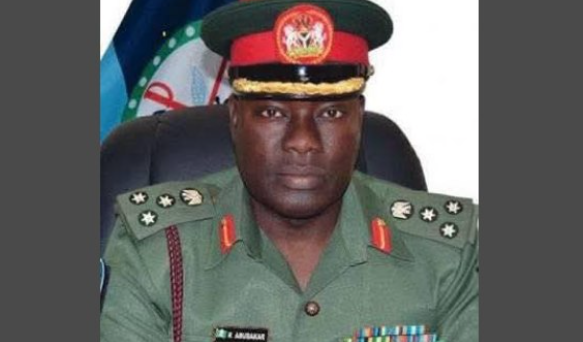
Retired military officers have called for urgent reforms to Nigeria’s security system following the death of retired Major General Rabe Abubakar.
The appeal was made during a press conference held in Kaduna by colleagues, friends and associates of the late military officer.
Speaking on behalf of the group, retired Brigadier General Isma’ila Abdullahi described the incident as a painful reminder of Nigeria’s worsening security challenges.
The gathering was attended by several retired senior military officers and notable public figures.
Among them were Brigadier General Abubakar Abdulqadir, Brigadier General M.I. Tsiga and Air Commodore Yusuf Anas.
Others included Ambassador Ibrahim Usman Gafai and Ambassador Ahmed Muhammad Musawa.
Abdullahi said the retired general died after being abducted by bandits in the Matazu area of Katsina State.
According to him, the loss has left family members, friends and former colleagues deeply devastated.
“Our colleague, friend, and brother, Major General Rabe Abubakar (rtd), died following his abduction by cruel bandits,” he said.
“His sudden death has left us shocked and deeply saddened,” Abdullahi added.
The retired officers acknowledged efforts by federal and state authorities that led to the rescue of the deceased’s wife.
However, they insisted that the tragedy highlights the urgent need for stronger action against insecurity.
According to the group, kidnapping, banditry and terrorism continue to threaten lives and undermine public confidence.
“The death of General Rabe Abubakar is not merely a headline,” Abdullahi stated.
“It underscores the difficulties facing a system struggling to guarantee the safety of citizens,” he added.
The retired officers warned against giving insecurity political, ethnic or regional interpretations.
They argued that the challenge affects all Nigerians and requires a united national response.
“We must resist the temptation to politicise insecurity,” Abdullahi said.
“This is a Nigerian problem that requires a collective national solution,” he added.
The group called for stronger security institutions and better coordination among security agencies.
They also advocated increased investment in intelligence gathering and border surveillance.
According to them, tighter border control is necessary to curb the influx of illegal weapons into the country.
The retired officers welcomed international cooperation in combating terrorism and organised crime.
However, they stressed that Nigeria must take primary responsibility for its own security.
“No foreign nation can secure Nigeria for us,” Abdullahi stated.
“International cooperation is important, but the responsibility for protecting Nigerians lies with our institutions and leadership,” he said.
The group also advocated stronger support for community-based security initiatives, especially in rural areas.
They argued that local volunteers and vigilante groups can play important roles when properly trained and supervised.
According to Abdullahi, communities should be empowered to assist in defending vulnerable areas against criminal attacks.
“When heavily armed bandits attack communities, it is unrealistic to expect local defenders to rely on outdated equipment,” he said.
He nevertheless cautioned against the uncontrolled spread of weapons among civilians.
Any community defence arrangement, he noted, must operate under strict regulation and government supervision.
The retired officers further urged state governments to establish and strengthen forest guard units.
They said recruitment alone would not be enough without adequate training, logistics and operational support.
“Creating forest guard units is only the first step,” Abdullahi said.
“Proper training and equipment are essential if they are to contribute meaningfully,” he added.
On the debate over state police, the group expressed conditional support for the initiative.
They maintained that only states with sufficient financial and institutional capacity should establish such structures.
“We are not opposed to state police,” Abdullahi explained.
“States seeking to establish such structures must demonstrate the ability to recruit, train, equip, and sustain them effectively.”
The retired officers also appealed for greater support to victims and families affected by insecurity.
They urged governments at all levels to intensify efforts to rescue citizens still being held captive.
According to them, the death of Major General Abubakar should serve as a wake-up call for decisive action.
They called for stronger political commitment and a coordinated national strategy to restore confidence in Nigeria’s security institutions.