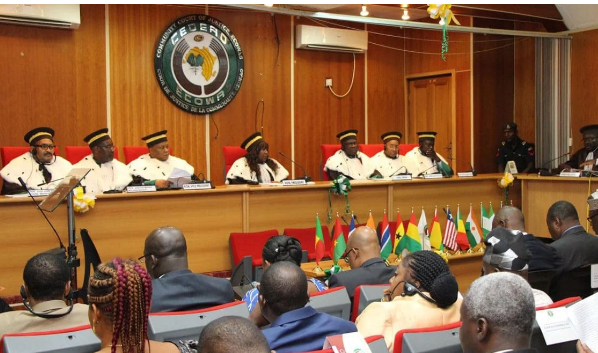
The Community Court of Justice of the Economic Community of West African States (ECOWAS) has dismissed a case filed by the Socio-Economic Rights and Accountability Project (SERAP) challenging Nigeria’s public borrowing practices, ruling that the group failed to sufficiently prove that the country’s debt profile had directly resulted in violations of citizens’ socio-economic rights.
The judgment was delivered by a three-member panel comprising Justice Sengu Mohamed Koroma (Presiding), Justice Gberi-Bè Ouattara, and Justice Edward Amoako Asante, who served as Judge Rapporteur.
In its judgment in Case No. ECW/CCJ/APP/05/22, the regional court held that while issues relating to government economic policies may fall within its human rights jurisdiction, any allegation of rights violation must be supported by clear, specific and verifiable evidence.
SERAP had approached the court arguing that Nigeria’s rising debt burden was becoming unsustainable and was undermining the government’s ability to provide essential public services such as healthcare, education and access to clean water.
The organisation further contended that the situation had worsened inequality and disproportionately affected vulnerable groups, in breach of obligations under the African Charter on Human and Peoples’ Rights and other international legal instruments.
The Federal Government of Nigeria, however, denied the allegations and urged the court to dismiss the suit in its entirety.
Delivering judgment, the ECOWAS Court affirmed its jurisdiction under Article 9(4) of its Protocol, noting that it is empowered to hear cases where state policies are alleged to have an impact on protected human rights.
The court also ruled the application admissible and acknowledged SERAP’s standing as a public interest litigant acting on behalf of Nigerian citizens.
However, the court found that SERAP failed to meet the required legal threshold in establishing its claims.
It noted that although the organisation presented data on Nigeria’s domestic and external debt and highlighted general economic hardship, it did not clearly identify specific rights that were allegedly violated, nor did it establish a direct legal link between government borrowing policies and the claimed violations.
The court further held that SERAP did not provide concrete evidence showing identifiable communities or groups that had suffered direct harm as a result of the borrowing practices.
Describing the case as largely based on broad economic concerns and general policy grievances, the judges ruled that it did not satisfy the evidentiary standards required in human rights litigation before the regional tribunal.
Consequently, the court dismissed the application in its entirety, holding that the alleged violations had not been substantiated in law or fact.