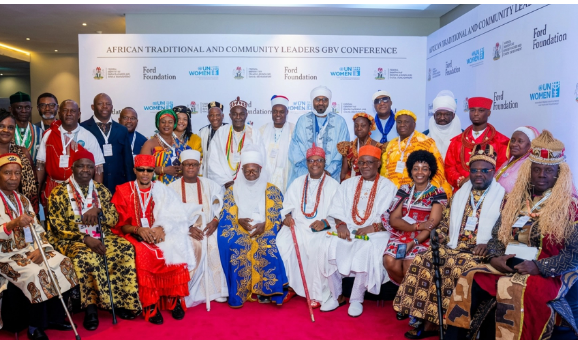
The Minister of Women Affairs, Hajiya Imaan Sulaiman-Ibrahim, says Nigeria is witnessing a steady decline in gender-based violence (GBV) and harmful traditional practices, but warned that sustaining the progress would depend heavily on the active involvement of traditional, religious and community leaders.
Speaking in Abuja at the close-out of the Leadership, Engagement, Advocacy and Prevention (LEAP) Project, the minister said recent national data showed encouraging improvements, but stressed that laws alone cannot eliminate violence against women and girls without deep community-level behavioural change.
According to findings from the 2024 Nigeria Demographic and Health Survey (NDHS), sexual violence against women dropped from nine per cent in 2018 to five per cent in 2024.
Physical violence since age 15 also declined from 31 per cent to 19 per cent, while intimate partner violence reduced from 36 per cent to 23 percent.
Female genital mutilation prevalence also fell from 20 per cent to 14 per cent.
The United Nations Women representative to Nigeria and ECOWAS, Beatrice Eyong, represented at the event by Acting Deputy Representative Patience Ekeoba, said the LEAP Project has shown that involving custodians of culture can drive lasting behavioural change in communities.
She explained that over the past three years, traditional and religious leaders were engaged to publicly reject harmful practices, while partnerships with governments and community structures were strengthened to improve prevention and response to GBV.
She added that men and boys were also brought in as allies in promoting gender equality and protecting women and girls.
Ekeoba noted that Nigeria’s progress is part of broader regional collaboration involving Liberia, Sierra Leone, Senegal, Niger and Ghana, which has produced a framework to strengthen the role of traditional leaders in preventing gender-based violence across West Africa.
However, she cautioned that despite the progress, fewer survivors were now seeking help, describing it as a worrying trend that calls for stronger reporting systems, survivor-centred services and improved access to justice.
The Ford Foundation-funded LEAP Project has now been concluded, but stakeholders announced a new regional programme titled “Community-Led Advocacy and Digital Spaces for the Safety of Women and Girls in West Africa,” aimed at tackling rising technology-facilitated violence such as online harassment, cyberstalking and image-based abuse.
UN Women said the new initiative would be implemented in Nigeria, Ghana and Senegal, with a continued focus on engaging traditional and religious leaders as key drivers of social change, while also addressing growing risks in digital spaces.
Stakeholders at the event agreed that while current statistics show progress, sustained reduction in GBV will require stronger community ownership, continued investment in prevention, and coordinated regional action to protect women and girls both offline and online.