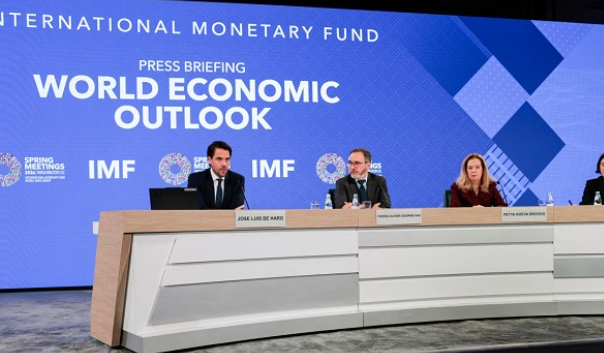
The International Monetary Fund has downgraded Nigeria’s 2026 economic growth forecast to 4.1 per cent, citing the continued impact of the Middle East war on global energy and supply chains.
The revision was announced on Tuesday during the IMF and World Bank Spring Meetings in Washington, D.C., where officials warned that war-driven shocks are weakening recovery prospects across several economies.
IMF Chief Economist, Pierre-Olivier Gourinchas, said the downgrade reflects broader pressures facing energy-importing countries, particularly in Sub-Saharan Africa.
“On Sub-Saharan Africa, we are seeing some downgrade of growth, and we are seeing some uptick in inflation in a number of countries in the region,” Gourinchas noted.
“The impact is very much along the lines of what we see more broadly for a lot of the countries, especially the ones that are energy importers,” he added.
He also explained that the Fund is closely monitoring developments and working with institutions such as the International Energy Agency and the World Bank to assess evolving needs in the energy market.
Speaking further, a senior official in the IMF Research Department, Deniz Igan, said the 0.3 percentage point downgrade reflects competing economic pressures.
“War-related higher fuel and fertilizer prices and higher shipping costs are going to weigh on non-oil activity in Nigeria.
“There’s some offset coming from higher oil prices, but the net balance is weaker growth in 2026, with some recovery built in for 2027,” Igan said.
The IMF also projected that median inflation in Sub-Saharan Africa will rise from 3.4 per cent in 2025 to about 5 per cent in 2026, driven by elevated oil and fertilizer prices, potential fuel shortages, and rising logistics costs.
For Nigeria, the Fund stressed that maintaining tight monetary policy would be crucial in achieving inflation targets set by the central bank.
Additionally, the IMF noted a decline in external financial support, revealing that bilateral aid to Sub-Saharan Africa dropped by between 16 and 20 per cent in 2025, removing a key buffer at a time when commodity prices and shipping costs are surging.