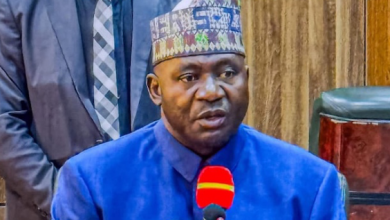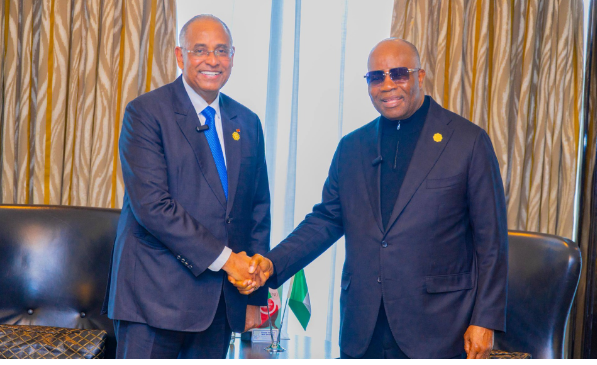
President of the Senate, Godswill Akpabio, has urged deeper regional integration across West Africa, calling on member states to coordinate efforts to strengthen economic and political cooperation amid increasing global uncertainty.
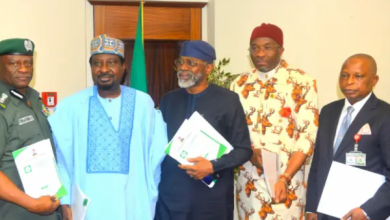
Akpabio made the appeal during a high-level meeting with the Speaker of the Ivorian National Assembly, Patrick Jérôme Achi, on the sidelines of the 152nd Assembly of the Inter-Parliamentary Union (IPU) in Istanbul, Turkey.
According to a statement from his Media Office on Sunday, both leaders emphasised the need for a stronger and more unified regional bloc capable of responding to global fragmentation and mounting economic pressures.
Describing Côte d’Ivoire as a key and long-standing partner, Akpabio warned that failure to deepen integration could expose West Africa to new forms of neocolonial influence.
He stressed that only a united regional framework would enable West African nations to fully benefit from trade, political cooperation, and cultural exchange.
Both leaders backed efforts to strengthen the Economic Community of West African States (ECOWAS), with particular attention to the reintegration of Sahel countries.
They described regional unity as essential for long-term economic stability and political resilience.
A major highlight of their discussions was the Abidjan–Accra–Lagos Coastal Highway project, a flagship infrastructure plan expected to transform transportation and trade across the subregion.
The project is designed to link major economic centres serving over 300 million people and reduce travel time between Lagos and Abidjan from about three days to approximately eight hours once completed.
The highway, conceived as a modern dual carriageway, will operate under a supranational legal framework intended to ease cross-border movement and eliminate bureaucratic bottlenecks.
The statement noted that five ECOWAS member states have already passed enabling laws to support seamless movement along the corridor.
Akpabio described the initiative as a “game-changer,” saying it would function as a major economic artery for West Africa. He also commended President Bola Tinubu for supporting the project.
Speaker Achi, in his remarks, stressed the importance of private-sector-driven growth, stating that governments should focus on creating enabling policies and strong legislative frameworks.
He called for urgent reforms to attract investment, expand markets, and tackle unemployment, particularly among young people in the region.
He identified peace, education, and economic opportunity as key pillars for development, warning that Africa risks stagnation if these areas are neglected.
Both leaders also pointed to persistent barriers to integration, including language differences, weak infrastructure, fragmented markets, and brain drain.
They called on African countries to better harness their human and natural resources, noting that the continent remains underutilised despite its vast wealth.
On security, they advocated the use of technology for border management, improved intelligence sharing, and coordinated surveillance systems to support open-border policies.
They also expressed concern over emerging threats such as digital and economic domination, urging increased investment in innovation and technology to safeguard Africa’s future.
The meeting ended with a commitment to strengthen parliamentary cooperation, harmonise legislative frameworks, and enhance oversight of regional initiatives.
Akpabio and Achi reaffirmed that Nigeria and Côte d’Ivoire remain central to West Africa’s transformation, expressing confidence that closer collaboration between both countries could unlock significant regional growth.