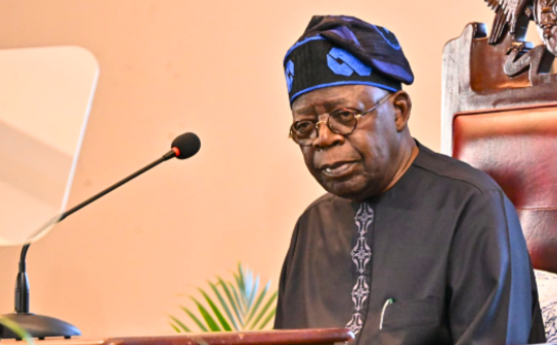
President Bola Tinubu has urged African nations to deepen economic cooperation and adopt policies that will strengthen industrialisation across the continent, insisting that Africa must begin processing its own resources and competing fairly in global markets.
Tinubu made the call on Tuesday while leading Nigeria’s delegation of government officials, diplomats and business leaders to the Africa Forward Summit held at the Kenyatta International Convention Centre in Nairobi, Kenya.
In a statement issued by presidential spokesman Bayo Onanuga, the Nigerian leader said Africa could no longer depend on exporting raw materials while importing finished products at higher costs.
The President also highlighted Nigeria’s vast blue economy potential, describing it as one of the continent’s most underdeveloped assets due to years of insecurity and uncertainty in maritime regions.
“Today, I make an explicit commitment: Nigeria will intensify regional coordination by offering our Deep Blue Project’s maritime intelligence infrastructure as a shared data hub for willing Gulf of Guinea states,” Tinubu stated.
He said African countries must work together through interoperable systems, harmonised maritime laws and joint enforcement mechanisms to improve regional security and unlock investment opportunities.
“Let no one misunderstand: maritime sovereignty does not repel investment, it attracts it. Secure sea lanes, predictable regulation, and functional courts are the preconditions that unlock private capital,” he said.
According to the President, Nigeria’s reforms in the maritime sector have reduced investment risks and created opportunities for climate-friendly port development and digital transformation within the industry.
Tinubu also declared that maritime sovereignty and ocean governance remain central to Africa’s blue economy ambitions.
“As we endorse the Nairobi Declaration, Nigeria affirms that maritime sovereignty and ocean governance are the non-negotiable foundations of Africa’s Blue Economy transformation,” he noted.
He added that Africa must move from what he described as “sea blindness” to “ocean sovereignty,” stressing that protecting and maximising ocean resources was a responsibility for future generations.
“The oceans have no duplicate as a common heritage of mankind. For Africa, moving from sea blindness to ocean sovereignty is not a choice, it is a generational duty,” the President added.
Tinubu also criticised the structure of the global financial system, arguing that it continues to weaken Africa’s industrial ambitions.
Referencing his address at the United Nations General Assembly last September, the President said Nigeria had already warned that the international system risked losing relevance if major reforms were not introduced.
He noted that Africa’s contribution to global manufacturing remains below two per cent despite decades of political independence.
“We export raw minerals, crude oil, and agricultural commodities, and we import processed goods at a premium,” Tinubu said.
According to him, the situation is driven by a global financial structure that denies African industries affordable capital, encourages illicit financial flows and imposes restrictions that developed nations themselves did not follow during their industrial growth stages.
Tinubu insisted Nigeria was not approaching the international community as a dependent nation but as a country implementing difficult economic reforms to stabilise its economy.
He pointed to the removal of fuel subsidies, exchange rate unification, banking sector recapitalisation and Nigeria’s exit from the Financial Action Task Force grey list as examples of reforms already undertaken by his administration.
“These reforms were sovereign choices, not external conditions,” the President stated.
He said the reforms had improved investor confidence, strengthened external reserves and contributed to a projected debt-to-GDP ratio of 32.3 per cent in 2026.
Despite these efforts, Tinubu argued that African countries still face borrowing conditions that make industrial development difficult.
The President disclosed that Nigeria would spend about 11.6 billion dollars on debt servicing in 2026, an amount he said represented nearly half of projected national revenue.
“Every single dollar that leaves our treasury to pay punitive interest rates is a dollar that did not go into our steel sector, our textile mills, our agro-processing plants, or our digital industries,” he lamented.
He added that Africa’s industries were being deprived of long-term and affordable financing while creditors continued to classify African economies as permanently high-risk, regardless of reforms or economic performance.
“So, I ask this gathering: how can an African manufacturer compete with a competitor in Europe, Asia, or North America when the cost of borrowing in our nations is five to ten times higher?” Tinubu asked.
He maintained that the current international financial architecture had become “an instrument of industrial disarmament for Africa.”
“Nigeria is not asking for charity. We are demanding a financial system that intentionally enables Africa to industrialise,” he stressed.
Tinubu said Africa must be empowered to refine its crude oil, process minerals, manufacture pharmaceuticals and compete globally without structural disadvantages.
On migration issues, the President argued that economic hardship and lack of opportunities remained major drivers of irregular migration across Africa.
He said many young Africans would avoid dangerous migration routes if jobs and economic opportunities were available in their home countries.
Tinubu explained that Nigeria had incorporated migration management into wider economic reforms, including agricultural modernisation and financial sector reforms.
He also urged international partners to invest more in climate adaptation, energy access, digital skills and employment-generating sectors.
According to him, part of Official Development Assistance should be channelled towards programmes capable of reducing irregular migration pressures across the continent.
The Nigerian leader also called for stronger African collaboration in shaping global migration policies.
He argued that existing international frameworks, including the Global Compact for Safe, Orderly and Regular Migration, remain inadequate because they are not legally binding.
Tinubu expressed support for African Union initiatives such as the Migration Policy Framework and the Khartoum Process, while urging closer coordination between regional and global migration systems.
On the sidelines of the summit, Tinubu met with Madagascar’s President Michael Randrianirina and also held discussions with CAF President Patrice Motsepe, where he reaffirmed Nigeria’s readiness to host the 2026 CAF Awards.
The President was accompanied by several cabinet members, including ministers responsible for foreign affairs, finance, agriculture, marine and blue economy, environment, communications and industry.
Leading Nigerian business figures at the summit included Aliko Dangote, Tony Elumelu, Abdulsamad Rabiu and Aigboje Aig-Imoukhuede.
Discussions at the summit focused on investment opportunities, artificial intelligence, digital transformation, agriculture, climate change, creative industries and strategies for translating policy discussions into industrial development across Africa.
The Africa Forward Summit, jointly hosted by French President Emmanuel Macron and Kenyan President William Ruto, attracted leaders and senior officials from more than 30 countries.
Opening remarks at the summit were delivered by Macron, Ruto, United Nations Secretary-General António Guterres and African Union Commission Chair Mahamoud Ali Youssouf.