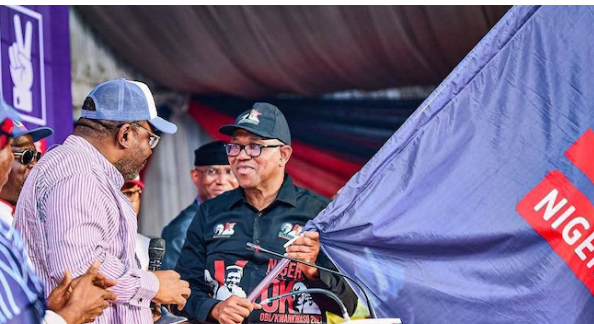
Former Labour Party presidential candidate, Peter Obi, has formally accepted his nomination as the National Democratic Congress (NDC) standard-bearer for the 2027 general elections, pledging wide-ranging reforms aimed at tackling insecurity, poverty, unemployment and governance failures.
Speaking at a special national convention in Abuja, where party delegates affirmed his candidacy, Obi declared that the 2027 election would centre on what he described as a national rescue mission and the rebuilding of public trust.
Addressing party leaders, Independent National Electoral Commission (INEC) representatives, delegates and supporters from across the country, Obi said his acceptance was driven by a commitment to national unity and institutional reform.
“It concerns the essence of our nation and the future of our children. It is about rekindling hope for millions who have faced adversity yet remain committed to Nigeria,” he said.
He added that Nigeria’s current challenges remained severe but not irreversible, insisting that credible leadership and collective effort could restore the country’s fortunes.
According to him, economic hardship had weakened businesses and communities while eroding public confidence in governance.
Obi emphasised that national unity must be the starting point for rebuilding the country, warning against continued ethnic, religious and regional divisions.
He argued that Nigeria’s diversity should be treated as a strength rather than a source of conflict.
“We should build bridges where others erect barriers, replace mistrust with confidence, division with understanding, and resentment with a collective purpose,” he stated.
On security, Obi promised an intelligence-driven and technology-supported system that would improve coordination among security agencies.
He said his administration would also focus on addressing the root causes of insecurity, including poverty, unemployment and social exclusion.
The former Anambra State governor described Nigeria’s primary healthcare system as inadequate and pledged major reforms in the sector.
He said he would more than double national health insurance coverage within four years and significantly increase healthcare funding.
According to him, every ward in the country would have access to a functional and properly managed primary healthcare centre, while at least half of Nigeria’s estimated 30,000 primary healthcare facilities would become fully operational within his tenure.
Obi also promised increased investment in education, describing human capital development as the foundation of national transformation.
On agriculture, he said Nigeria must shift from consumption to production, stressing that the country’s vast arable land should position it as a global food producer rather than one facing persistent hunger.
He pledged aggressive investment in rural development and food security to boost local production.
In the energy sector, Obi identified electricity as a critical driver of industrial growth and economic expansion.
He pledged to increase power generation and distribution by at least 10,000 megawatts within four years, describing it as essential to economic recovery and job creation.
Obi concluded by reaffirming his belief in what he called “a New Nigeria,” insisting that national renewal was achievable through disciplined leadership and sustained reforms.