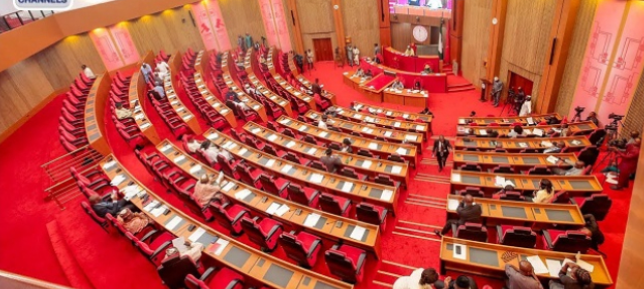
The Senate has advanced two key legislative proposals aimed at increasing the number of judges in Nigeria’s superior courts, a move lawmakers believe will help reduce case backlogs and improve the speed of justice delivery across the country.
The bills, which passed second reading during plenary on Wednesday, seek to raise the number of judges of the Federal High Court from 70 to 90 and increase the number of Justices of the Court of Appeal from 70 to 110.
Leading the debate on the proposed legislation, Senate Leader, Senator Opeyemi Bamidele, said the measures were designed to strengthen the judiciary and equip it to effectively manage the growing volume of cases before the courts.
According to him, a functional democracy depends on the ability of citizens and institutions to obtain timely judicial decisions whenever disputes arise.
He stressed that the justice sector must be adequately staffed and supported with the resources needed to discharge its constitutional responsibilities.
Speaking on the proposed amendment to the Court of Appeal Act 2004, Bamidele noted that the appellate court occupies a critical position within Nigeria’s judicial structure, serving as the bridge between trial courts and the Supreme Court as provided under Section 237 of the 1999 Constitution, as amended.
He explained that the bill seeks not only to increase the number of appellate justices but also to ensure fair representation of all states and the Federal Capital Territory within the court’s composition.
The Senate leader added that the legislation would address issues relating to seniority and ranking among justices, strengthen administrative operations within the court and enhance the overall efficiency of appellate proceedings.
Bamidele further argued that expanding the bench of the Federal High Court had become necessary due to the increasing workload on judges across the country.
According to him, the additional judges would help reduce the huge number of pending cases, improve access to justice through quicker hearings and judgments, and strengthen the prosecution of corruption and financial crime cases.
He also maintained that faster resolution of commercial disputes would improve investor confidence in Nigeria’s economy, while specialised sectors such as banking, telecommunications, aviation, maritime affairs and intellectual property would benefit from more efficient judicial processes.
The proposals received broad support from senators during debate, with no opposition recorded against their passage at the second reading stage.
Following deliberations, the upper chamber referred the bills to the Senate Committee on Judiciary, Human Rights and Legal Matters for detailed consideration.
The committee has been given four weeks to review the proposals and submit its report to the Senate for further legislative action.