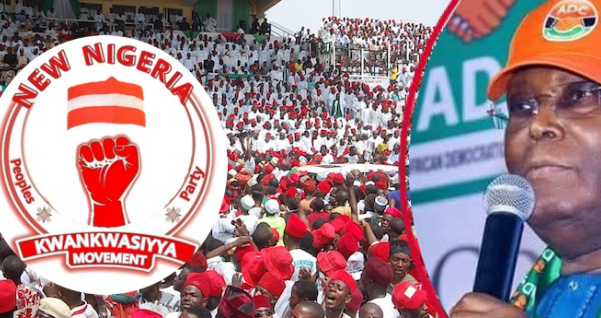
Amid growing political manoeuvring within the opposition African Democratic Congress (ADC) ahead of the 2027 elections, the Kwankwasiyya movement has pushed back against recent remarks attributed to former Vice President Atiku Abubakar regarding the political relevance of former Kano State Governor, Rabiu Kwankwaso.
Atiku had reportedly suggested a decline in Kwankwaso’s political influence in Kano, a position the movement strongly rejected, insisting that both Kwankwaso and Labour Party’s Peter Obi retain what it described as “organic” nationwide support.
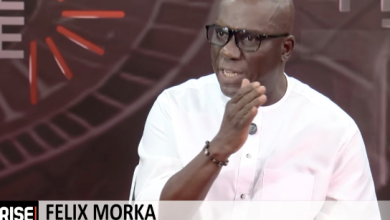
Speaking during a televised interview, the spokesperson of the Kwankwasiyya movement, Hon. Habib Mailemo, argued that the followership enjoyed by both politicians is driven by personal conviction rather than political patronage or established party structures.
He maintained that Atiku’s electoral strength has largely been tied to political alliances and party machinery, particularly within the Peoples Democratic Party (PDP), rather than independent mass appeal.
“It is only Peter Obi and my principal, Alhaji Rabiu Musa Kwankwaso, who have organic followers that are not induced by anything.
“Their aspirations align with the belief in their competence and proven track records, and the masses identify with them, ” he said.
He also stressed that the ongoing political conversation should focus less on rivalry and more on the broader goal of national renewal, noting that Kwankwaso’s participation in opposition coalition discussions is driven by what he described as a mission to “rescue Nigeria.”
“My principal has made it very clear that we are going into the coalition simply because his sole intention is to contribute to rescuing Nigeria,” he added.
Reacting to claims that Kwankwaso’s influence in northern Nigeria may not match Atiku’s, Mailemo acknowledged Atiku’s long political history but argued that his repeated electoral performances were often supported by strong party structures and elite backing.
He said Atiku’s past presidential runs benefited significantly from the PDP’s established political machinery and the support of governors across the country.
“It is true that Atiku has contested multiple times, particularly under the PDP, where he had the backing of governors and a strong structure.
“But he cannot solely attribute the votes he garnered to personal popularity, ” he said.
In contrast, the Kwankwasiyya spokesperson insisted that both Obi and Kwankwaso had demonstrated the ability to generate political momentum independently of dominant party systems, especially in elections where they were initially not considered frontrunners.
He argued that their political impact in recent electoral cycles reflected growing voter-driven support rather than institutional backing.
“I am giving you a different scenario where Peter Obi and Kwankwaso stood on their own and became synonymous with the parties they joined, largely because of their personal popularity,” Mailemo stated.
He added that a fair comparison of political strength would require all key figures to compete under similar conditions without relying on entrenched party structures.
“If he had contested under a platform without an established structure and built it into a formidable force as they did, then we could properly assess the strength of his personal appeal,” he said.
Mailemo also referenced historical political transitions, including the emergence of the late President Umaru Musa Yar’Adua, to illustrate the importance of party structures in electoral outcomes. He argued that strong institutional backing often plays a decisive role in determining election victories.
“Yar’Adua may not have been the most popular at the time, but with a strong party structure and broad-based support, he emerged as president,” he noted.
Addressing concerns that such exchanges could deepen divisions within opposition ranks, he urged coalition actors to embrace internal dialogue and objective assessment ahead of the 2027 elections.
“The expectation is that key figures within the coalition, including Atiku, Obi, and Kwankwaso, should come together, understand themselves, and conduct a proper analysis of their strengths.
“That is the only way they can arrive at a credible position to challenge the ruling government and offer Nigerians a viable alternative, ” he said.