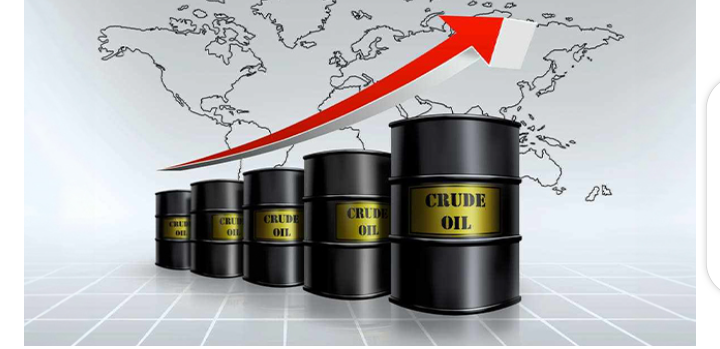
Global oil prices climbed sharply on Monday following renewed tensions in the Middle East, after Iran again shut the Strait of Hormuz over the weekend, citing a blockade of its ports by the United States.
The development came just a day after Tehran had briefly reopened the vital shipping route, raising hopes of stability in global energy markets.
Despite the escalation, investor sentiment remained cautiously optimistic, supported by lingering expectations that a diplomatic resolution to the seven-week crisis could still be reached.
However, Iranian authorities indicated they were not planning to participate in upcoming peace talks.
Oil markets had previously slumped on Friday after Iran signalled a temporary reopening of the strait, a key passage through which about a fifth of the world’s oil and liquefied natural gas flows.
The move followed a ceasefire agreement involving Israel and Lebanon.
At the time, US President Donald Trump said negotiations were nearing completion.
“We’re very close to having a deal,” he said, adding that there were “no sticking points at all” remaining with Tehran.
Iran, however, quickly dismissed the claim, insisting that its stockpile of enriched uranium would not be transferred abroad.
Following Friday’s optimism, U.S. benchmark West Texas Intermediate dropped more than 11 per cent, while Brent crude fell about nine per cent.
Prices rebounded strongly on Monday as geopolitical risks resurfaced ahead of the end of a two-week ceasefire.
The surge followed reports of continued U.S. enforcement of a blockade and an incident involving an American naval vessel seizing an Iranian ship accused of attempting to evade restrictions.
Tehran warned it would retaliate, further heightening concerns over supply disruptions.
Iranian state-linked media reported that there were currently no plans to attend a new round of talks with Washington, expected to take place in Pakistan.
Officials cited the U.S. blockade as a major obstacle to negotiations, with sources describing the atmosphere as “not very positive.”
Earlier diplomatic efforts, including a 21-hour meeting held in Islamabad on April 11, ended without a breakthrough, although behind-the-scenes discussions have continued.
In a social media post on Sunday, Trump reiterated his stance, saying: “We’re offering a very fair and reasonable DEAL, and I hope they take it,” while also warning of potential action against Iran’s infrastructure if talks fail.
Meanwhile, Iran’s Revolutionary Guards issued a stern warning, stating that any unauthorised vessel passing through the strait would be treated as hostile.
Foreign ministry spokesman Esmaeil Baqaei described the U.S. blockade as “a violation” of the ceasefire.
Oil prices responded quickly, with West Texas Intermediate rising by more than seven per cent at one point, while Brent crude gained over six per cent.
Equity markets, however, extended gains, buoyed by hopes that diplomacy could still prevent a full-scale escalation.
Major indices, including the S&P 500 and Nasdaq, closed at record levels in New York.
Asian markets also posted strong performances, with Tokyo, Seoul, and Taipei leading gains amid a renewed rally in technology stocks.
Other markets, including Hong Kong, Shanghai, Wellington, and Manila, also advanced.
The U.S. dollar, which had weakened on Friday, regained strength against major currencies as investors reassessed risks.
Market analysts said traders remain cautious, closely watching whether diplomatic efforts can stabilise the situation in the coming days, even as uncertainty continues to dominate the outlook.