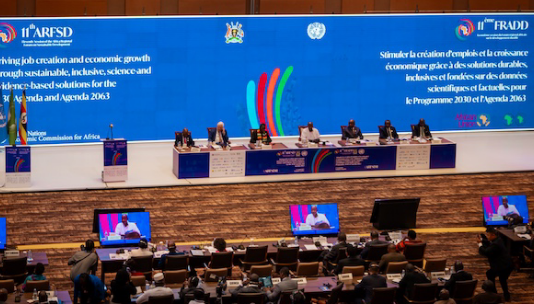
African leaders have officially opened the “Twelfth Session of the Africa Regional Forum on Sustainable Development (ARFSD-12)” in Addis Ababa, Ethiopia, with a renewed appeal for urgent, coordinated and transformative action aimed at accelerating progress on the United Nations 2030 Agenda for Sustainable Development Goals (SDGs) and Africa’s Agenda 2063.
According to a statement released on Wednesday by the United Nations Economic Commission for Africa (ECA), the Forum is being held under the theme “Turning the Tide: Transformative and Coordinated Actions for the 2030 Agenda and Agenda 2063.”
It has brought together ministers, senior government officials, regional institutions, United Nations agencies, civil society groups, private sector actors and development partners to assess Africa’s progress and shape a unified position ahead of global development discussions, including the High-Level Political Forum.
Opening the session, Uganda’s Prime Minister, Robinah Nabbanja, who also chaired the Bureau of the Eleventh Africa Regional Forum on Sustainable Development, urged African countries to move decisively from policy commitments to measurable implementation results.
“With only four years remaining to 2030, we must move with urgency – from commitments to concrete, measurable results,” Nabbanja said.
She added that African countries must make stronger use of science, technology and innovation, deepen regional integration, expand innovative financing mechanisms, and strengthen partnerships in order to achieve the goals.
Nabbanja also expressed appreciation to the Government and people of Ethiopia for hosting the Forum in Addis Ababa, while commending the United Nations Economic Commission for Africa for its continued leadership in advancing the continent’s sustainable development agenda.
She referenced the adoption of the Kampala Declaration and the Key Messages to the High-Level Political Forum in 2025, noting that the Bureau had remained actively engaged over the past year through four meetings aimed at providing strategic direction, maintaining momentum and strengthening implementation follow-up.
According to her, progress has been recorded in aligning national development plans with the SDGs, improving data systems for evidence-based planning, strengthening coordination mechanisms and shifting emphasis towards faster implementation.
However, she cautioned that financing gaps, climate vulnerability, and the need for expanded innovation and partnerships remain major constraints.
She also stressed that peace and security, the African Continental Free Trade Area (AfCFTA), and key infrastructure enablers such as transport systems, reliable energy supply and reduced business costs are essential to development.
“These enablers are not optional. They are fundamental to the full realisation of the AFCFTA and to positioning Africa as a competitive and integrated economic bloc,” she said.
Delivering remarks on behalf of the Chairperson of the African Union Commission, Mahmoud Youssouf, Deputy Chairperson Selma Haddadi commended Uganda for its leadership of the outgoing Bureau and for promoting Africa’s positions at global platforms including the High-Level Political Forum, the World Summit for Social Development, and the United Nations Climate Change Conference.
Haddadi noted that ARFSD-12 is taking place at a critical moment, as progress across many African countries remains insufficient to meet the 2030 SDG targets.
“This Forum represents not just a platform for reflection, but a decisive moment for collective action,” she said.
She explained that this year’s focus on five SDGs: clean water and sanitation; affordable and clean energy; industry, innovation and infrastructure; sustainable cities and communities; and partnerships for the goals—is strategic, as these areas are central to sustainable development and closely aligned with Agenda 2063 aspirations.
Haddadi also reported progress in the domestication of the Second Ten-Year Implementation Plan of Agenda 2063, noting that member states are increasingly aligning national development plans, policies and budgets with continental priorities.
Preliminary findings from an upcoming report pointed to gains in infrastructure development, regional integration and digital transformation, including through initiatives such as the AfCFTA.
However, she warned that significant challenges remain, particularly in development financing, youth employment, climate resilience and inequality within and between countries.
She also emphasised that partnerships remain critical to Africa’s success, highlighting the 2018 Memorandum of Understanding between the African Union and the United Nations as a key framework that has strengthened coordination, reduced fragmentation and improved programme delivery across the continent.
As discussions continue, participants are expected to develop concrete recommendations to strengthen Africa’s collective voice in global development processes and accelerate implementation at national, regional and continental levels.
The African Union Commission reaffirmed its commitment to working with partners to accelerate both Agenda 2063 and the 2030 Agenda.
“Together, we can indeed turn the tide and build a prosperous, inclusive and sustainable Africa,” Haddadi said.