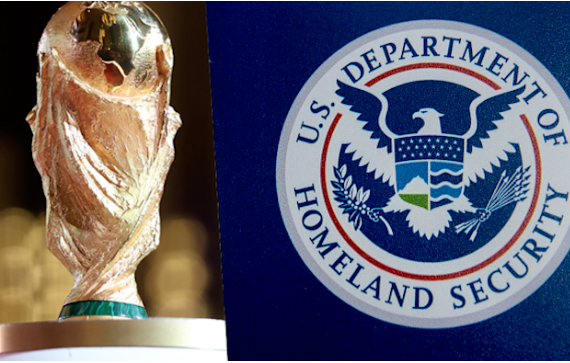
Officials at the White House have warned that reopening the Department of Homeland Security (DHS) is “essential” ahead of this summer’s FIFA World Cup, citing heightened security concerns following a recent attempted attack on President Donald Trump.
The concerns emerged after a man, identified by prosecutors as Cole Tomas Allen, was charged with attempting to assassinate the president during a gala event in Washington, DC.
According to court filings, the suspect was armed with a semi-automatic handgun, a pump-action shotgun, and multiple knives when he forced his way past a security checkpoint at the White House Correspondents’ Association dinner on Saturday.
Andrew Giuliani, executive director of the White House World Cup task force, described the incident as a “sobering reminder” of the security threats facing the United States.
He said that although the rapid response of law enforcement and Secret Service agents prevented any casualties, the episode underscored the urgent need for a fully operational Department of Homeland Security.
“As we prepare for the unprecedented scale of the World Cup, reopening DHS is essential,” Giuliani said.
The department has been partially shut down for more than nine weeks due to an ongoing funding dispute in Congress.
The impasse stems from Democratic opposition to funding Immigration and Customs Enforcement (ICE), an agency under DHS without reforms, following two fatal incidents involving federal agents in Minneapolis in January.
Officials have warned that the shutdown is already disrupting coordination between federal and local agencies, raising concerns about preparedness for the tournament, which is expected to attract millions of international visitors.
Political pressure is increasing to resolve the deadlock.
President Donald Trump has urged lawmakers to reach an agreement by early June, while Republican Congressman Mike Lawler described the situation as “insane,” warning of the risks of hosting a global sporting event under current security constraints in a high-profile target environment.
The expanded 48-team FIFA World Cup, jointly hosted by the United States, Canada, and Mexico from June 11 to July 19, is projected to be one of the largest sporting events in history, placing significant demands on security and logistics planning across the three host nations.