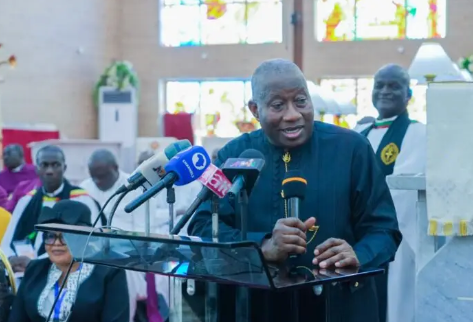
Former President of Nigeria, Goodluck Jonathan, has called on religious leaders across the country to step up prayers and moral guidance as Nigeria continues to face growing social, security, and ethical challenges.
Jonathan made the appeal during the opening session of the 13th Synod of the Anglican Diocese of Abuja, held at St. James Anglican Church, Asokoro, where church leaders, delegates, and invited guests gathered to reflect on national issues and the role of the church in nation-building.
He expressed concern over what he described as a steady decline in respect for human life and increasing cases of violence and social disorder.
According to him, the moral tone of society has weakened significantly, leaving communities more vulnerable to conflict and distrust.
The former president said everyday interactions among citizens now reflect a worrying level of insensitivity and aggression.
He reflected on the broader human condition and shared a personal illustration, noting: ”I remember listening to a song in which the singer spoke about Christ.
”He said that if Christ were still with us on earth and looked down at what is happening in our societies today, He would be deeply troubled by the way we treat one another.”
Jonathan acknowledged the consistent role religious institutions have played in sustaining national hope, stressing that spiritual intercession has remained a stabilising force.
“The Church has continued to play a key role. I always feel that if religious leaders had not been praying seriously for this country, things would probably have been far worse than what we are witnessing today, ” he said.
He further warned that moral decay was becoming more visible among young people, citing rising incidents of cult-related violence in schools and communities.
He also pointed to the growing influence of social media, saying that while technology has benefits, it has also exposed many youths to harmful content that shapes negative behaviour patterns.
Despite these concerns, Jonathan expressed optimism about Nigeria’s future, saying difficult national periods are not unusual in global history.
He maintained that with determined leadership and collective effort, the country could still recover and grow stronger.
“God will not abandon Nigeria. Many societies we admire today passed through painful and difficult periods before attaining stability and prosperity,” he said.
He stressed that national transformation required deliberate leadership decisions and sustained commitment, not wishful thinking.
Jonathan urged Nigerians to set aside divisions and work together to address insecurity, economic hardship, and declining public trust in governance, expressing confidence that the country can still achieve stability if citizens and leaders act responsibly.
In his remarks, the Archbishop and Primate of the Church of Nigeria, Anglican Communion, Most Rev. Henry Ndukuba, delivered a strong critique of the current political climate, warning that preparations for the 2027 general elections are already overshadowing governance.
He said political actors appear more focused on survival and election strategies than on addressing citizens’ welfare, noting that this trend is deepening public frustration.
“It is clear that the political class is jostling for its survival rather than the service and welfare of the people.
”Our political leaders have abandoned governance to pursue their strategy for contesting the 2027 elections, ” he said.
He also raised concerns about frequent defections among politicians and what he described as weakening opposition politics, saying these developments reduce accountability and deepen instability in the democratic process.
The cleric urged the Independent National Electoral Commission (INEC) to remain impartial and ensure fairness to all political actors ahead of the elections.
On the economy, he acknowledged government reforms but said their impact has yet to significantly improve living conditions for ordinary citizens.
While referencing recent inflation figures and exchange rate stability, he stressed that macroeconomic improvements have not translated into reduced hardship for the majority of Nigerians.
He said, ”with 133 million out of 220 million Nigerians in multidimensional poverty, macroeconomic gains have not reached the citizens on the streets.”
Also speaking at the synod, Senate President Godswill Akpabio, represented by Senator Ireti Kingibe, highlighted the importance of the church in shaping national values, saying it remains a critical institution for moral guidance and social stability.
He described the church as a foundational force that nurtures conscience, restores hope, and strengthens ethical behaviour in society.
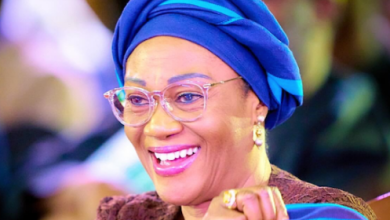
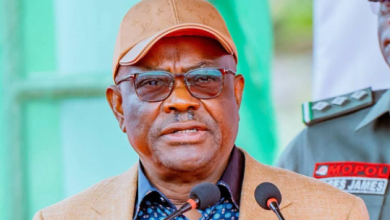
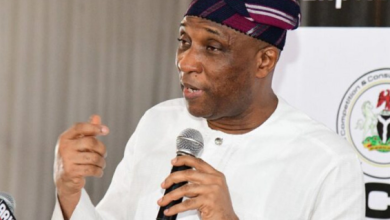
The event was attended by several prominent figures including former Head of State, General Yakubu Gowon (rtd), former Imo State Governor Emeka Ihedioha, and former Chief of Staff to the President, Mike Oghiadomhe, among others.