The World Health Organisation has raised the Ebola outbreak risk level in the Democratic Republic of Congo to its highest category as infections and deaths continue to rise across affected communities.
WHO Director-General Ghebreyesus
Tedros described the situation as “deeply worrisome,” warning that the outbreak is spreading rapidly despite ongoing containment efforts.
According to the global health body, the national risk level for DR Congo has now been upgraded from “high” to “very high,” while the regional risk remains high and the global risk level remains low.
Speaking during a press briefing, Tedros disclosed that nearly 750 suspected Ebola cases and 177 suspected deaths had already been recorded in the country.
“The Ebola outbreak in the Democratic Republic of the Congo is spreading rapidly,” he said.
“So far, 82 cases have been confirmed in DRC, with seven confirmed deaths. But we know the epidemic in DRC is much larger.
”There are now almost 750 suspected cases and 177 suspected deaths.”
The WHO chief added that health workers were intensifying efforts to trace contacts linked to infected persons in order to contain further spread of the deadly virus.
Tedros noted that the situation in neighbouring Uganda appeared stable despite two confirmed Ebola cases linked to travellers from DR Congo.
According to him, one death has been recorded in Uganda, but emergency measures introduced by authorities have helped limit transmission.
“The situation in Uganda is stable, with two cases confirmed in people who travelled from DRC, with one death,” he stated.
He explained that aggressive contact tracing and the cancellation of the Martyrs’ Day celebrations were among the steps taken to reduce the risk of wider infections.
The WHO also confirmed that a United States citizen working in DR Congo tested positive and was transferred to Germany for treatment, while another American classified as a high-risk contact was moved to the Czech Republic for monitoring.
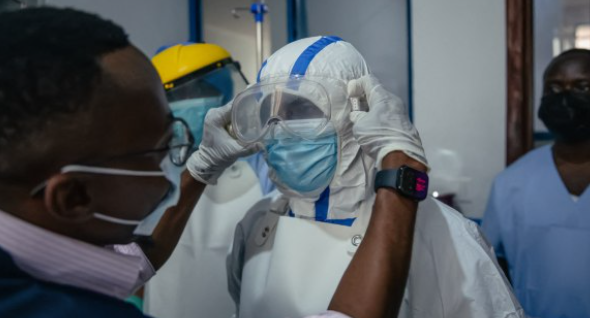
Tedros said 22 international emergency personnel had already been deployed to affected areas alongside local medical teams.
“Some of our most experienced people are now on ground supporting the response,” he added.
The WHO warned that insecurity and violence in parts of eastern Congo are making it difficult for health workers to effectively contain the outbreak.
Officials said fear, mistrust, and attacks on medical facilities have complicated efforts to isolate patients and conduct safe burials.
Ebola, a deadly viral disease spread through direct contact with bodily fluids, can trigger severe bleeding, organ failure, and death.
Health authorities explained that no approved vaccine or treatment currently exists for the Bundibugyo strain responsible for the latest outbreak.
There have only been two previous outbreaks linked to the same strain — one in Uganda in 2007 and another in DR Congo in 2012.
WHO chief scientist Sylvie Briand said the organisation was reviewing available medical tools that could help combat the outbreak while prioritising safety and effectiveness.
She revealed that the agency’s technical advisory group had recommended two monoclonal antibodies for clinical trials.
The WHO is also evaluating the antiviral drug obeldesivir as a possible preventive treatment for individuals exposed to high-risk infections.
Briand said the treatment appeared “promising” in preventing infected contacts from developing the disease.
She further confirmed that discussions were ongoing with international partners over the possible development of vaccines targeting the Bundibugyo strain.
Tension escalated in Ituri Province after angry residents and relatives of Ebola victims attacked a hospital treating infected patients.
Rioters reportedly set ablaze isolation tents at Rwampara Hospital following the death of a 24-year-old man believed to have contracted the virus.
Hospital officials said the violence erupted after family members demanded custody of the deceased’s body for burial rites.
“The family wanted us to hand over his body so that they can bury him, but given the circumstances, that’s impossible,” a hospital official explained.
Security forces later intervened to restore calm after warning shots were fired to disperse protesters. A nurse was reportedly injured during the unrest after being hit by stones.
Authorities said resistance to emergency burial procedures continues to fuel mistrust among residents.
In many rural communities, grieving relatives still insist on touching bodies and conducting traditional funeral rites despite warnings from health officials.
Civil society leader Jean Ezadri said the practice remains widespread.
“Loved ones are throwing themselves at the bodies, touching the corpses and the clothes of the deceased while organising mourning rituals bringing together loads of people,” he said.
“Unfortunately, this is going on even during this epidemic, which explains the many instances of contamination.”
Some grieving families in the affected communities also questioned the existence of the virus and accused authorities of withholding bodies unnecessarily.
“My brother is not dead from Ebola, it’s an imaginary disease,” said 22-year-old Jeremie Arwampara.
Another relative, Ezekiel Shambuyi, openly challenged health officials during the standoff.
“Why are they refusing to give us the bodies? He’s my big brother, I cannot be afraid of him,” he shouted.
Under military escort, health workers later transported three coffins to a cemetery outside the town for emergency burials.
Relatives watched in tears as workers dressed in full protective gear lowered the bodies into graves after disinfecting the coffins.
“They’re going to bury our father without us seeing him, it breaks my heart,” said Musa Amuri, whose father was among the victims.
Residents in the region continue to accuse the Congolese government of responding too slowly to the outbreak, especially in rural communities where healthcare infrastructure remains poor.
Medical workers also warned that many hospitals still lack proper isolation and triage facilities, increasing the risk of further infections among patients and staff.