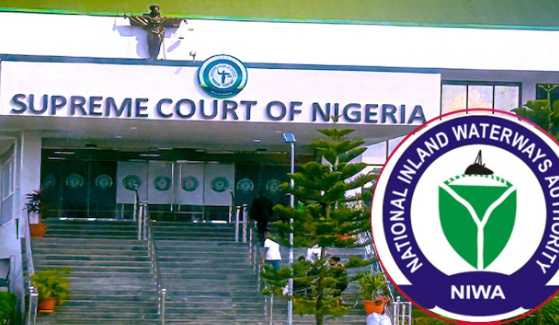
The Supreme Court of Nigeria has ruled that parts of the National Inland Waterways Authority (NIWA) Act are unconstitutional, holding that the Federal Government cannot exercise control over lands adjoining inland waterways for purposes outside navigation within individual states.
The judgment was delivered in Suit No. SC/CV/541/2025 in a constitutional dispute between Lagos State Government and the Federal Government over the scope of federal authority on inland waterways and surrounding lands.
The case was argued by senior lawyers including Babatunde Fashola (SAN), Olasupo Shasore (SAN), and Muiz Banire (SAN) for Lagos State, while Akin Olujini (SAN) represented the Federal Government.
The seven-member panel was led by Justice Mohammed Lawal Garba, with Justice Abubakar Sadiq Umar reading the lead decision.
Other justices on the panel included Emmanuel Akomaye Agim, Chidiebere Nwaoma Uwa, Haruna Simon Tsammani, Stephen Jonah Adah, and Mohammed Baba Idris.
The apex court delivered a largely unanimous judgment, except on issues concerning Sections 10 and 11 of the NIWA Act, where the decision was split 5–2.
Justices Emmanuel Agim and Mohammed Baba Idris dissented, arguing that additional reliefs sought by Lagos State should have been granted.
Lagos State had initiated the suit through the Supreme Court’s original jurisdiction, challenging Sections 10, 11, 12, and 13 of the NIWA Act.
The state argued that the National Assembly exceeded its constitutional powers by extending federal authority beyond navigation-related matters.
It further contended that federal control should be limited to international and inter-state waterways as defined by the Constitution.
In its ruling, the Supreme Court held that Sections 12 and 13 of the NIWA Act were unconstitutional to the extent that they granted powers over adjoining lands for purposes unrelated to navigation, maritime activity, and fishing.
The court said the National Assembly acted beyond its constitutional authority under Items 36 and 64 of the Exclusive Legislative List by expanding federal control over such lands.
As a result, Sections 12 and 13 were declared null and void to the extent of their inconsistency with the Constitution.
However, the court declined to invalidate Sections 10 and 11 of the Act, citing its earlier decision in NIWA v. Lagos State Waterways Authority (LSWA).
The apex court also refused to rule that the National Assembly lacks legislative authority over inland waterways not classified as international or inter-state routes.
Injunction Restricts Federal Activities
The Supreme Court further granted a perpetual injunction restraining the Federal Government from engaging in any non-navigational activities involving lands adjoining waterways within Lagos State Government and other states of the federation.
The court also dismissed preliminary objections raised by the Federal Government and other defendants, which had challenged the Supreme Court’s jurisdiction to hear the matter.
The ruling is expected to reshape the balance of regulatory powers between federal authorities and state governments regarding inland waterways and adjoining land use across Nigeria.