The Director-General of the World Health Organization (WHO), Tedros Adhanom Ghebreyesus, has arrived in eastern Democratic Republic of Congo (DRC) as international efforts intensify to contain a rapidly growing Ebola outbreak that has already claimed hundreds of lives.
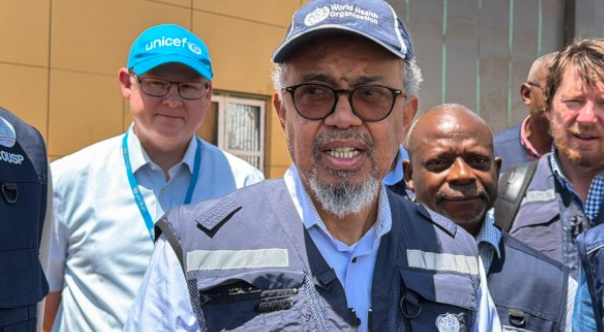
Tedros landed in Bunia, the capital of Ituri Province, on Saturday, making a high-profile visit to the region at the centre of the epidemic.
His trip comes amid mounting concerns over the speed of transmission and the challenges facing health workers battling the deadly disease.
Speaking shortly after his arrival, the WHO chief stressed the importance of involving local communities in the fight against Ebola, noting that medical interventions alone would not be enough to halt the outbreak.
The international community, he said, remains committed to supporting the Congolese government, but community participation remains a critical factor in the response effort.
“We are here to discuss with the community, to see how the response is running and if there are challenges to help,” Tedros told reporters in Bunia.
According to him, understanding local concerns and strengthening cooperation between residents and health authorities are essential to controlling the spread of the virus.
Health officials said the outbreak has expanded rapidly since it was officially declared on May 15.
Figures released by the Africa Centres for Disease Control and Prevention indicated that at least 1,077 suspected Ebola cases have been recorded across the DRC, while 246 people have died from the disease.
The outbreak has already spread across three provinces in eastern Congo and crossed into neighbouring Uganda, where authorities have confirmed nine infections, including one fatality.
Experts fear the actual number of infections may be considerably higher than reported.
The WHO has warned that the virus may have been circulating unnoticed for some time before health authorities officially detected and declared the outbreak.
Limited laboratory capacity in affected areas has further complicated efforts to accurately determine the scale of infections.
The growing health crisis has prompted neighbouring countries to strengthen border controls and surveillance measures.
Uganda this week closed its border with the DRC and introduced a mandatory 21-day quarantine for travellers arriving from the affected country.
Despite the alarming figures, health officials reported a positive development on Friday when a patient recovered from the disease and was discharged after producing two consecutive negative test results.
WHO representative Anais Legand described the discharge as the first successful recovery among laboratory-confirmed Ebola patients during the current outbreak.
The development has offered a measure of hope to health workers and affected communities as efforts to contain the disease continue.
Medical experts said the response is being severely hampered by insecurity across eastern Congo.
For decades, the region has been plagued by armed conflict involving multiple militia groups, making access to vulnerable communities extremely difficult.
In Ituri Province, where the outbreak is most severe, government presence remains limited in several areas due to attacks by armed groups, including militants linked to the Allied Democratic Forces (ADF).
Neighbouring North Kivu and South Kivu provinces, which have also reported Ebola cases, continue to experience persistent violence and instability.
Large sections of those provinces are currently under the influence of the M23 rebel movement, which has been engaged in prolonged clashes with government forces.
The ongoing conflict has displaced millions of people, many of whom now live in overcrowded camps with poor sanitation and limited access to healthcare.
Public health experts feared such conditions could accelerate the spread of Ebola if urgent preventive measures are not implemented.
Particular concern surrounds the vast network of camps housing internally displaced persons across the eastern region.
Nearly one million displaced people are currently sheltering in Ituri Province alone.
Aid agencies warn that a major outbreak within the camps could have devastating consequences due to overcrowding and inadequate hygiene facilities.
Among those expressing concern is Dorcas Mapenzi, a resident of the Kingonze displacement camp near Bunia.
“If Ebola comes, we’ll be wiped out as we’re packed like sardines,” she said.
Her fears reflect growing anxiety among thousands of displaced families who remain vulnerable to both disease and conflict.
Humanitarian organisations have also raised concerns about the scale of resources available to combat the epidemic.
Doctors Without Borders (MSF) described the current outbreak as unprecedented in its early stages.
According to the medical charity, “never has an Ebola epidemic recorded so many cases in the first days after it being declared.”
MSF warned that the number of health experts currently deployed to affected areas remains insufficient considering the speed at which infections are increasing.
The organisation called for additional personnel, equipment and funding to strengthen emergency response operations.
The current outbreak is being driven by the Bundibugyo strain of Ebola, a variant for which there is presently no approved vaccine or specific treatment.
This has heightened concerns among public health authorities and increased the urgency of containment efforts.
However, there is cautious optimism that a vaccine may become available in the coming months.
The head of Africa CDC disclosed this week that researchers are working towards developing a vaccine for the strain, with expectations that one could be ready before the end of the year.
Until then, health authorities continue to rely on surveillance, isolation, contact tracing and community awareness campaigns as the primary tools for containing the outbreak.
As the epidemic spreads across borders and threatens vulnerable populations, the visit by the WHO chief underscores the seriousness of the crisis and the urgent need for coordinated international action to prevent a wider humanitarian disaster.