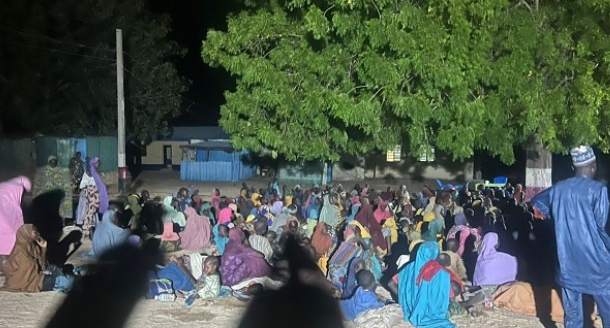
A major military operation in Borno State has resulted in the rescue of 360 abducted persons from a terrorist stronghold hidden within the rugged Mandara Mountains, marking one of the largest hostage recovery missions in the North-East in recent years.
Troops of the Joint Task Force (North East), operating under Operation HADIN KAI, carried out the mission after weeks of intelligence gathering, surveillance and strategic planning aimed at dismantling a notorious insurgent enclave linked to Jama’atu Ahlis Sunna Lidda’awati wal-Jihad (JAS).
Military authorities described the operation as a significant breakthrough in ongoing efforts to weaken terrorist networks and secure vulnerable communities affected by years of insurgency.
According to Lieutenant Colonel Haruna Sani, Acting Media Information Officer of Operation HADIN KAI, the rescued victims included men, women and children who had been held in captivity under harsh conditions after being abducted from several communities, particularly around the Ngoshe axis of southern Borno State.
He explained that the mission was launched after security agencies obtained credible intelligence identifying the exact location of the hostages and uncovering a sophisticated support structure sustaining the terrorist camp.
Military intelligence units subsequently intensified surveillance activities, combining information from multiple sources to build a comprehensive picture of the area before launching the rescue operation.
The intelligence effort involved the use of Human Intelligence (HUMINT), Signals Intelligence (SIGINT), unmanned aerial surveillance platforms and long-range reconnaissance patrols.
Through continuous monitoring and analysis, commanders were able to gain detailed knowledge of the terrain, the positions of insurgent fighters, their movement patterns and the conditions under which the hostages were being held.
Security officials said the intelligence-driven approach significantly reduced risks to the captives and provided troops with a clear operational advantage before the assault commenced.
A major breakthrough reportedly came when intelligence operatives successfully penetrated the terrorist network, obtaining crucial information about the location of the hostages, internal security arrangements and planned movements within the camp.
At the same time, psychological and information operations were carried out to create confusion among the insurgents, weakening their cohesion and disrupting command structures within the enclave.
Armed with real-time intelligence, Special Forces and troops from Sector One launched a carefully coordinated multi-directional assault designed to isolate the objective area and block potential escape routes.
Under the cover of darkness, assault teams advanced toward the target while supporting units secured strategic positions around the mountainous terrain to prevent reinforcements or withdrawals.
Military authorities said the operation achieved complete tactical surprise, leaving the insurgents unable to organise an effective response.
Faced with the speed and precision of the advancing troops, several terrorists reportedly fled into surrounding mountainous areas, while others surrendered.
The hostages were quickly secured, screened and evacuated from the area before being transferred to safe locations for medical treatment and humanitarian assistance.
Despite the overall success of the mission, the military confirmed that two infants died from exhaustion during the evacuation process due to the difficult terrain and the severe conditions they had endured while in captivity.
The rescue operation has been widely hailed as a major setback for the insurgents and a demonstration of the growing effectiveness of intelligence-led military operations in the region.
The Military High Command commended the professionalism, courage and discipline displayed by personnel involved in the mission, describing the outcome as evidence of improved coordination among security agencies and stakeholders.
Authorities also assured the public that follow-up operations are underway to hunt down fleeing insurgents, dismantle remaining support networks and prevent future abductions.
Community Group Confirms Release
Meanwhile, the Borno South Youth Alliance (BOSYA) confirmed that the abductees from Ngoshe were released on Saturday night.
Speaking on behalf of the organisation, its president, Samaila Ibrahim-Kaigama, disclosed that four babies born during captivity died from infections before the rescue, while their mothers are currently receiving medical care at a government facility.
The group welcomed the return of the victims and praised efforts that contributed to their freedom.
“We are happy and grateful that through our efforts, our persistent cries, and long discussions, the results are now being seen,” the organisation said in a statement.
It added that leadership requires standing up for vulnerable citizens and working tirelessly to save lives, describing the return of the women and children as a moment of relief for families and communities across Southern Borno.
BOSYA also called on federal, state and local authorities to conduct comprehensive screening, rehabilitation and support programmes for the rescued victims to aid their recovery and reintegration.
The successful rescue has brought renewed hope to communities affected by insurgency, while highlighting the continuing efforts of security forces to restore peace and stability across Nigeria’s North-East region.