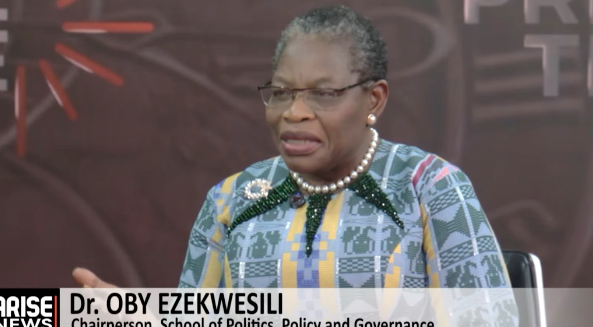
Former Education Minister, Dr Oby Ezekwesili, has challenged Nigerians to reject the belief that the country’s worsening condition is inevitable, insisting that Nigeria’s current reality is the result of a flawed national design that can and must be changed.
Ezekwesili made the declaration in an exclusive interview with ARISE NEWS, on Monday where she also reaffirmed her support for former Anambra State Governor, Peter Obi, ahead of the 2027 presidential election.
But she cautioned Nigerians against making the 2027 contest solely about individual politicians, arguing that the bigger challenge is to build a political system capable of consistently producing competent and accountable leadership.
For Ezekwesili, the crisis goes beyond elections. She said years of deteriorating living conditions have gradually weakened Nigerians’ sense of the value and dignity of human life.
“What we have to show for it is the complete collapse of the dignity of the human being and the dignity of life. It’s like we have zeroed out on the value of life, and yet we continue to think that somehow, if we just keep doing elections, we’ll be fine,” she said.
She urged citizens to put their own interests at the centre of their political choices.
“I am challenging that and saying that Nigerians should at least vote for themselves. If no one votes for you in terms of the leaders you’re choosing, vote for yourselves, ” she said.
Ezekwesili described what she considers one of Nigeria’s most dangerous political attitudes: resignation.
She argued that too many citizens have come to accept poor governance, insecurity, poverty and institutional failure as unavoidable features of Nigerian life.
“The greatest tragedy of the country is this resignation that this is our destiny. I say no, this is by design.
“It is not our destiny, this is by design. This design needs to be challenged,” she said.
She called for a fresh national conversation that would address Nigeria’s identity, shared values and the relationship between citizens and government.
According to her, the country has never adequately undertaken the difficult conversation required to transform Nigeria from a geographical expression into a cohesive nation with a common sense of purpose.
“The design that we run right now has not worked for us, we do need to design again,” she said.
Ezekwesili said the opportunity for such a conversation was missed after independence, when Nigeria should have begun defining the values and national vision that would bind its diverse population together.
“What I am arguing for is that since the independence of our country, we’ve not really had the kind of conversation that we should have had immediately the British left the scene,” she said.
On the 2027 presidential election, Ezekwesili acknowledged the enormous advantages enjoyed by incumbents and established political structures, particularly their access to financial resources and political machinery.
Yet she said elections could still produce unexpected outcomes when citizens collectively reach a point of rejecting the status quo.
She noted that severe economic hardship could influence voting behaviour, especially among households struggling to meet basic needs.
Research linked to FixPolitics and the School of Politics, Policy and Governance, she said, had highlighted the connection between low productivity, weak household incomes and political choices.
But she maintained that hardship does not necessarily eliminate the possibility of a political awakening.
“But we’ve also seen situations where the people vote for themselves. They come to that point where they sort of say, ‘You know what? Okay, we’ve had it. We’ve really had it. We can’t continue on this trajectory because it actually is too injurious,’” she said.
Ezekwesili reaffirmed her support for Peter Obi, explaining that her position is based on her long-standing assessment of leadership through three key qualities: character, competence and capacity.
She said she applied the same criteria during the 2023 presidential election and saw Obi as the stronger candidate based on those standards.
“In 2023, I made it very clear that, using the criteria on which I see leadership either fail or succeed to govern well… the other two candidates score considerably lower than what you would assign to former Governor Obi, and so I was going to stand with Governor Obi.
“I don’t think that anything has really significantly changed,” she said.
However, she warned against turning the national conversation into a personality contest centred on Obi.
“Don’t make this about Peter Obi. I don’t want us to personalise. I’m interested in the construct,” she said.
For Ezekwesili, Nigerians should apply the same standards to candidates seeking offices at the local, state and federal levels.
She urged more Nigerians with strong character, competence and capacity to enter politics and contest both legislative and executive positions, arguing that better leadership cannot be achieved by focusing only on presidential elections.
Reflecting on her time in government, Ezekwesili also discussed her disagreements with former Vice President Atiku Abubakar, stressing that her concerns were rooted in policy and reform rather than personal differences.
She recalled the country’s heavy debt burden and efforts to create fiscal space for increased investment in sectors such as education and healthcare.
She also highlighted reforms in public procurement, saying concerns over the management of Nigeria’s resources strengthened her determination to ensure that government obtained greater value for public money.
The experience, she suggested, reinforced a central conviction: Nigeria’s problems cannot be solved simply by replacing one political personality with another.
For Ezekwesili, the ultimate task is to redesign the institutions and political system so that good governance becomes the norm rather than an exception.
Her message ahead of 2027 is therefore broader than a call to support one candidate.
It is a challenge to Nigerians to abandon political resignation, demand better leadership and participate actively in rebuilding the country’s national design.