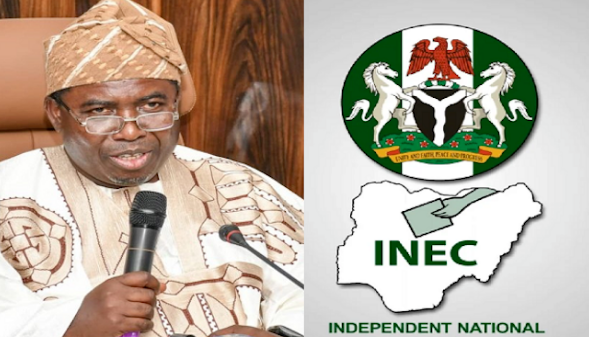
The Independent National Electoral Commission (INEC) has announced that it will issue official access codes to all registered political parties on Friday, 26 June 2026, to enable them access the Candidate Nomination Portal ahead of upcoming elections.
INEC Chairman, Professor Mahmood Yakubu Amupitan, made the disclosure on Tuesday in Abuja during the Commission’s Second Quarterly Consultative Meeting with leaders of political parties.
He explained that the access codes would allow designated national officers of political parties to upload candidates’ names, personal details, and other required documentation through the Commission’s digital platform.
Amupitan also said preparations for the Ekiti State governorship election scheduled for Saturday, 20 June 2026, are on track, describing the level of readiness as satisfactory.
He disclosed that the Commission recently undertook a high-level assessment visit to Ekiti State to evaluate logistics, technology deployment, and operational readiness ahead of the poll.
According to him, the voter register for the election currently stands at 1,059,360 registered voters. This figure, he noted, includes 66,664 newly registered voters from the Continuous Voter Registration exercise added to the 2023 baseline register of 987,647 voters.
He also revealed that 2,103 cases of double registration had been identified and removed to safeguard the integrity of the register.
“In line with our commitment to maintaining the integrity of the Register, 2,103 registrations identified as cases of double registration were invalidated,” he said.
Amupitan assured that logistics arrangements, election technology deployment, staff training, and stakeholder engagements were progressing according to schedule.
He added that all 2,445 polling units across the 16 local government areas of Ekiti State would open simultaneously at 8:30 a.m. on election day.
The INEC chairman also addressed recent court rulings concerning the Commission’s timetable and schedule of activities for the 2027 general elections, noting that legal clarity remains necessary.
He referenced two Federal High Court judgments, one of which questioned aspects of the Commission’s electoral timetable, while another affirmed INEC’s authority to regulate election timelines but nullified certain provisions relating to nomination and substitution of candidates.
Amupitan said the Commission had filed appeals to obtain definitive rulings from higher courts, stressing the need for certainty in electoral administration.
He maintained that election timelines are interconnected operational processes required to ensure orderly and credible elections.
“Without this timetable, there would be chaos in our electoral system,” he said.
According to him, key processes such as party membership register submission, monitoring of party primaries, candidate nomination, printing of election materials, and quality assurance must be properly coordinated within a unified framework.
He stressed that while the Electoral Act provides timelines for some activities, several critical processes are not explicitly timed but remain essential to the electoral calendar.
Amupitan assured political parties and Nigerians that INEC remains committed to constitutional provisions, the Electoral Act, and judicial decisions while preparing for the 2027 general elections.
He urged political parties to prepare adequately for the nomination process, noting that the online portal would close automatically once deadlines expire.
“The credibility of elections depends on collective commitment to the rule of law, democratic values, and integrity of the process,” he said.
Also speaking, National Chairman of the Inter-Party Advisory Council (IPAC), Dr. Yusuf Dantalle, said Nigeria’s democratic institutions must continue to evolve to strengthen electoral integrity and political stability.
He emphasised that the credibility of elections is rooted in the transparency of internal party processes, which serve as the foundation of democratic participation.
Dantalle noted that political parties remain central to democratic governance and that their internal conduct significantly influences the quality of elections and leadership outcomes.