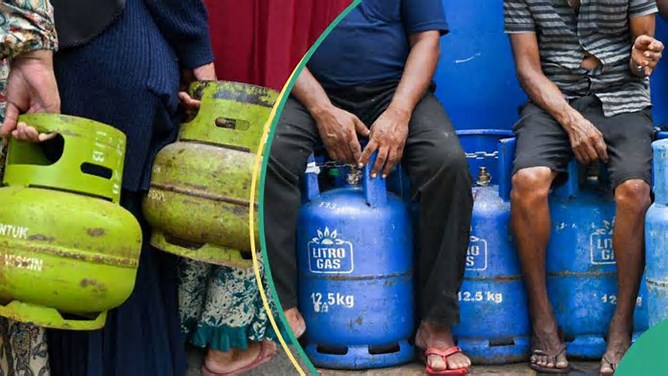
The Federal Government has convened an emergency stakeholders’ meeting to tackle the hoarding and diversion of Liquefied Petroleum Gas (LPG), commonly known as cooking gas.
The meeting brought together representatives of the Economic and Financial Crimes Commission (EFCC), the Department of State Services (DSS), and the Nigeria Police Force.
According to the Nigerian Midstream and Downstream Petroleum Regulatory Authority (NMDPRA), the action follows the recent surge in cooking gas prices across the country.
The authority said the engagement was aimed at developing coordinated measures to improve supply, affordability, and stability within the LPG market.
The meeting also attracted government officials, industry regulators, producers, marketers, terminal operators, and various associations within the gas sector.
Participants examined the major causes of rising LPG prices and discussed practical solutions to strengthen the industry’s value chain.
Speaking during the engagement, Permanent Secretary of the Ministry of Petroleum Resources, Patience Oyekunle, described LPG as a vital source of energy for households.
She said cooking gas remains an important part of Nigeria’s energy transition agenda and economic development plans.
Oyekunle noted that the increase in LPG prices is placing additional pressure on household finances and driving up the cost of essential goods.
She stressed the need for collective action to ensure Nigerians have better access to affordable cooking gas.
Minister of State for Petroleum Resources (Gas), Ekperikpe Ekpo, said President Bola Tinubu is concerned about the impact of rising LPG prices on citizens.
According to him, the President has directed relevant agencies to take proactive measures to address the situation.
Ekpo emphasised that increasing supply alone is not enough to solve the problem.
He said improved logistics, better infrastructure, and transparent pricing systems are necessary to ensure consumers benefit from government interventions.
The Authority Chief Executive of NMDPRA, Mallam Rabiu Umar, said high landing costs continue to influence LPG prices nationwide.
However, he expressed optimism that ongoing efforts across the value chain would ease market pressure in the coming weeks.
Umar stated that the authority is collaborating with producers and other stakeholders to boost domestic supply and strengthen market oversight.
He added that the goal is to improve product availability and support measures that will stabilise the market.
In a presentation delivered by the Executive Director of Distribution Systems, Storage and Retailing Infrastructure, Ogbugo Ukoha, the authority identified several factors affecting LPG prices.
These include infrastructure deficits, domestic supply limitations, logistics challenges, market distortions, and disruptions in global supply chains.
Ukoha disclosed that recent engagements with producers, suppliers, and terminal operators have already produced encouraging results.
According to him, national LPG supply sufficiency increased from 11 days to 22 days.
He also revealed that average daily supply rose from 4,262 metric tonnes in May 2026 to 5,040 metric tonnes in June 2026.
Stakeholders across the LPG value chain pledged support for government efforts aimed at addressing the challenges facing the sector.
They highlighted issues affecting storage capacity, transportation, distribution networks, and overall market efficiency.
Participants agreed on several measures to improve the industry and protect consumers.
The resolutions include intensified market monitoring, stronger enforcement against malpractice, and expansion of storage and distribution infrastructure.
Other measures include increased domestic production, improved product tracking systems, greater access to market data, and stronger collaboration among stakeholders.
In his closing remarks, Ekpo directed all stakeholders to immediately implement measures that will improve supply and eliminate inefficiencies.
He said the success of the intervention would be measured by increased LPG availability, improved distribution efficiency, and reduced price pressure across the country.