Environmental experts, traditional leaders and academics have warned that Nigeria risks repeating the mistakes of decades of oil exploitation in the Niger Delta if urgent reforms are not introduced in the governance of its growing solid minerals sector.
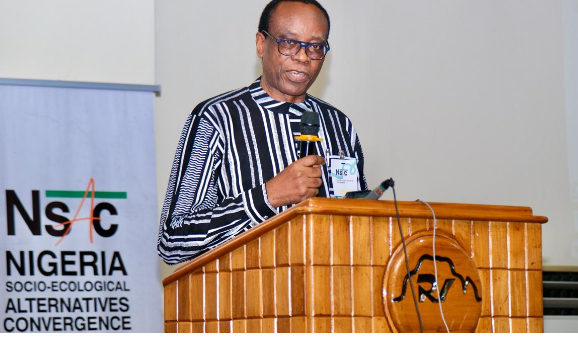
The stakeholders issued the warning on Tuesday at the Third Nigeria Socio-Ecological Alternatives Convergence (NSAC) in Abuja, where they raised concerns that the global demand for critical minerals could trigger environmental destruction, conflict and inequality similar to the challenges associated with crude oil extraction.
The conference, themed “Deforestation, Mining and the Crisis of Human Security in Nigeria,” brought together traditional rulers, environmental activists, academics, civil society groups and community representatives to examine the implications of Nigeria’s expanding role in the global energy transition.
The discussions followed the Federal Government’s recent announcement of a major polymetallic mineral discovery in Kaduna State, containing strategic resources including lithium, rare earth elements, gold, copper, nickel and platinum group metals.
The government has described the discovery as a major opportunity to position Nigeria as a key supplier of minerals required for electric vehicle batteries, renewable energy technologies and advanced manufacturing.
However, participants at the conference warned that mineral wealth could become another source of exploitation unless stronger environmental protections, community participation and transparent governance systems are established.
Professor of Anthropology and African Studies at the University of Michigan, Professor Omolade Adunbi, warned that critical minerals could become “the new oil” if Nigeria adopts the same extractive approach that characterised the petroleum industry.
Adunbi said the global push for renewable energy must be accompanied by questions about who controls mineral resources, who benefits from them and who bears the environmental costs.
“The world must decarbonise. But the deeper question is what kind of decarbonisation, governed by whom, for whose benefit, and at whose cost?” he said.
He noted that while renewable technologies are promoted as solutions to climate change, they depend heavily on minerals extracted from communities whose forests, rivers and farmlands could be destroyed in the process.
Drawing lessons from the Niger Delta, Adunbi warned that critical minerals could reproduce patterns of displacement, ecological damage, insecurity and elite control if not properly regulated.
He called for the adoption of a “Just Minerals Strategy” that would ensure legally binding community consent, prevent mining in environmentally sensitive areas, guarantee ecosystem restoration and provide host communities with a fair share of mineral revenues.
Also speaking, environmentalist and Director of the Health of Mother Earth Foundation (HOMEF), Nnimmo Bassey, questioned whether Nigeria had learned from the consequences of oil extraction in the Niger Delta before embracing another resource-driven development model.
“Have we learned the lessons of almost seven decades of oil extraction in the Niger Delta?” he asked.
Bassey argued that Nigeria’s forests, rivers and communities continue to suffer under an economic model that prioritises resource extraction over environmental protection and human welfare.
He raised concerns over the country’s declining forest cover, stating that Nigeria loses between 250,000 and 300,000 hectares of forest annually, with primary forests now accounting for only about 1.3 per cent of the country’s landmass.
He warned that continued deforestation could result in the near-total loss of Nigeria’s forests by 2052.
Beyond logging and agricultural expansion, Bassey criticised some carbon credit initiatives, describing them as a form of “carbon colonialism” that could exclude indigenous communities from lands they have protected for generations.
He cited large-scale forest carbon projects in parts of Delta and Niger states, warning that such schemes could dispossess local communities if their rights are ignored.
The environmentalist also linked environmental degradation to rising insecurity, arguing that abandoned and degraded forests are increasingly being used as bases by criminal groups.
“Some forests have become habitats not for wildlife but for wild humans — bandits and terrorists — who disconnect communities from their forests and turn the territories into criminal fiefdoms,” he said.
The Chairman of the occasion and Emir of Nasarawa, Alhaji Ibrahim Usman Jibril, also expressed concern over the relationship between illegal mining, deforestation and insecurity.
The monarch said criminal groups were increasingly exploiting mineral-rich areas, using proceeds from illegal mining and timber trafficking to finance their activities while forcing communities from their ancestral lands.
He described the relationship between resource exploitation, environmental destruction and insecurity as a cycle of violence and deprivation.
“The nexus between mining, forest extraction, insecurity and Nigeria’s socio-ecological crisis forms a vicious cycle of resource plunder, environmental degradation and violent conflict,” he said.
The Emir acknowledged that minerals such as lithium, tantalite and rare earth elements present significant economic opportunities but stressed that development must not come at the expense of communities and the environment.
“Our natural resources are a blessing, but only if they are governed with justice, accountability and sustainability,” he said.
He blamed weak environmental regulation, corruption and political interference for enabling illegal exploitation of natural resources and called for stronger enforcement mechanisms.
The monarch also urged greater involvement of traditional institutions in protecting forests and managing conflicts linked to resource exploitation.
Throughout the conference, participants highlighted the increasing connection between environmental damage and national security.
They argued that forests affected by illegal mining and logging are becoming safe havens for kidnappers and bandits, while competition over natural resources continues to fuel community disputes.
The experts warned that declining global dependence on fossil fuels could push Nigeria into replacing oil dependence with mineral dependence without addressing the governance failures that created past challenges.
They advocated a shift away from a “dig now, regulate later” approach, calling for stronger environmental laws, mandatory community consultation, transparent licensing processes, local mineral processing and restoration of damaged ecosystems.
Participants also challenged the idea that renewable energy automatically guarantees environmental justice, arguing that the clean energy transition must not create new sacrifice zones in mineral-producing communities.
They called for legally enforceable Free, Prior and Informed Consent (FPIC) before mining licences are granted, allowing communities to participate meaningfully in decisions affecting their ancestral lands.
The conference concluded that Nigeria faces a critical choice: either repeat the extractive practices that left the Niger Delta burdened by pollution, conflict and poverty, or establish a new minerals governance framework built on sustainability, accountability and community rights.
Participants stressed that a successful transition to a green economy must deliver justice not only for the climate but also for the people living in areas where critical minerals are found.