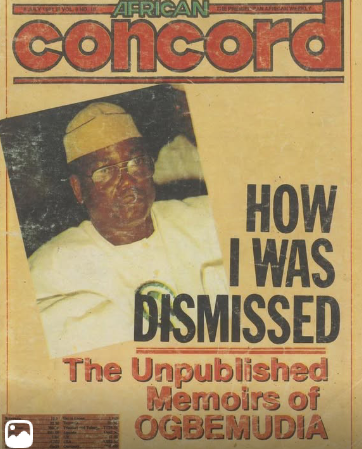
Brigadier Samuel Osaigbovo Ogbemudia was, by 1975, one of Nigeria’s most influential military governors.
Having governed the Mid-Western State, later Bendel State, from 1967 to 1975, he earned widespread praise for his ambitious development projects and administrative achievements.
However, shortly after General Murtala Mohammed overthrew General Yakubu Gowon’s government on July 29, 1975, Ogbemudia’s fortunes changed dramatically.
A Federal Assets Investigation Panel set up by the new military government investigated several former military governors over allegations of corruption and abuse of office.
The panel found Ogbemudia guilty of corrupt enrichment, leading to his dismissal from the Nigerian Army.
For a man widely regarded as one of the country’s brightest military administrators, it marked a dramatic fall from grace.
Years later, Ogbemudia strongly challenged the verdict.
In an interview published by African Concord in July 1991, he stopped short of claiming he had been deliberately framed. Instead, he argued that the investigation was compromised by conflicts of interest.
According to him, one of the judges on the panel had previously been dismissed by him while he was governor. He also claimed that another panel member had been removed from office under his administration.
To Ogbemudia, these circumstances raised serious questions about whether the investigation could truly have been impartial.
He asked rhetorically: “If I sack this man and later he becomes chairman to probe me, what do you expect?”
Although he refused to accuse anyone directly of conspiracy, he maintained that the composition of the panel made fairness difficult to achieve.
Reflecting on the January 15, 1966 coup, Ogbemudia described it as the turning point in Nigeria’s political instability.
He argued that the coup disrupted the country’s democratic evolution, insisting that if the First Republic had survived longer, politicians would have learned from their mistakes and the political system would have matured naturally without military intervention.
He also revealed that Major Chukwuemeka Nzeogwu never informed him about the coup plans. When asked whether he would have participated if he had known beforehand, Ogbemudia described the question as hypothetical, adding that if he had foreseen the consequences, he might have made a different decision.
Speaking on Major General Johnson Aguiyi-Ironsi, Ogbemudia described the former Head of State as a hardworking, intelligent and physically imposing officer, whom he regarded as “a good soldier rather than a politician.”
He recalled advising Ironsi to strengthen his personal security, warning that not everyone around a Head of State could be trusted.
According to him, he even wrote to Ironsi recommending additional security measures, believing that some of those recommendations were not implemented before Ironsi was assassinated during the July 1966 counter-coup.
Ogbemudia also revisited one of the most controversial episodes of the Nigerian Civil War.
As Military Governor of the Mid-West, he acknowledged the deep ethnic divisions that existed within the military following the January and July 1966 coups.
He maintained that the Mid-West fell to invading Biafran forces in August 1967 because certain military officers betrayed the region, a position that differs from the account presented by former military governor David Ejoor in his memoirs.
The differing narratives remain part of the enduring historical debate surrounding the Civil War.
Despite his dismissal from the Army, Ogbemudia’s public career did not end.
In December 1980, the Bendel State House of Assembly passed a vote of confidence in his record as military governor.
He was appointed Chairman of the National Sports Commission in 1987 and had earlier served briefly as the civilian Governor of Bendel State between October and December 1983.
Historical accounts also state that the Nigerian Army later reviewed the cases of governors dismissed after the 1975 coup, with Ogbemudia eventually being rehabilitated.
His achievements in Bendel State—including the establishment of the University of Benin, expansion of healthcare, sports development, road construction and agricultural programmes—continued to shape his legacy despite the controversy surrounding his dismissal.
Today, Samuel Ogbemudia remains one of Nigeria’s most respected former military administrators.
Yet, decades after his removal from the Army, questions over whether he was treated fairly or justifiably dismissed continue to generate debate among historians and students of Nigerian political history.
Heart 2 Heart With Sammy
#Nigeria #History #SamuelOgbemudia #MilitaryHistory #BendelState #NigerianCivilWar #Heart2HeartWithSammy