An economist, Elder Godwin O. Ossai, has called for a fundamental shift in Nigeria’s economic governance, urging policymakers to adopt practical, evidence-based and interdisciplinary approaches to tackle the country’s persistent development challenges.
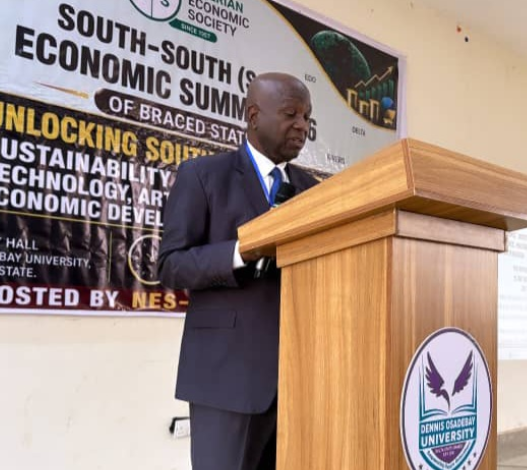
Ossai made the call while delivering the keynote address at the 2026 Nigerian Economic Society (NES) South-South Regional Annual Conference held at Dennis Osadebe University, Asaba, Delta State.
Speaking on the theme, “Unlocking South-South Potentials: Sustainability and Transformation; Technology, AI and Economic Development Issues and Policy,” he said Nigeria’s economic difficulties were not caused by a shortage of competent economists but by the inability of political leaders to implement sound economic policies.
“Nigeria’s economic predicament is not due to a shortage of competent economists but the absence of political leaders with the courage and patriotism to implement sound economic policies, ” he said.
The economist expressed concern over what he described as the decline of deliberate economic planning, noting that governments increasingly rely on ad hoc decisions, weak data and budgets that are rarely evaluated for their impact on citizens.
He urged institutions such as the Nigerian Economic Society (NES), the Nigerian Institute of Social and Economic Research (NISER) and the Nigerian Economic Summit Group (NESG) to champion evidence-based policy formulation capable of reversing the country’s economic decline.
Ossai also advocated a review of economics curricula in Nigerian tertiary institutions to align academic training with the country’s socio-economic realities.
According to him, economists must work more closely with sociologists, political scientists and psychologists to develop practical solutions to Nigeria’s development challenges.
Speaking on the conference’s sub-themes, he stressed the need for strategic investment in human capital, stronger public institutions and deeper regional collaboration in infrastructure development, particularly in power, transportation and energy.
On technology, Ossai said Nigeria had yet to fully harness the opportunities presented by artificial intelligence, robotics, blockchain, big data and the Internet of Things, adding that the country remained heavily dependent on imported technologies.
He called on researchers and policymakers to prioritise indigenous technological innovation and bridge the nation’s widening digital gap.
The economist also identified corruption as one of Nigeria’s biggest obstacles to sustainable development, urging more empirical research to determine its true impact on public finances.
According to him, findings from an unpublished study indicate that corruption accounts for a significant share of public sector investment expenditure.
He further criticised the exclusion of agriculture from the conference’s major discussion themes, insisting that the sector remains central to Nigeria’s industrialisation, food security and economic transformation.
Ossai identified corruption, poor leadership, a self-reinforcing cycle of poverty and insecurity as the major barriers to Nigeria’s industrial growth and economic progress.
He urged scholars and policymakers to move beyond conventional economic theories and focus on practical, policy-oriented research capable of addressing Nigeria’s unique socio-economic realities.