Nigeria’s former leaders and prominent voices in politics, law and academia have renewed the call for a fundamental rethink of democracy in Africa, arguing that the continent’s current political structures are failing to deliver good governance, accountability and shared prosperity.
The concerns dominated discussions on Tuesday as African leaders, jurists, scholars and development partners gathered in Bauchi for the Goodluck Jonathan Foundation Democracy Dialogue 2026, which focused on governance, elections and institution-building.
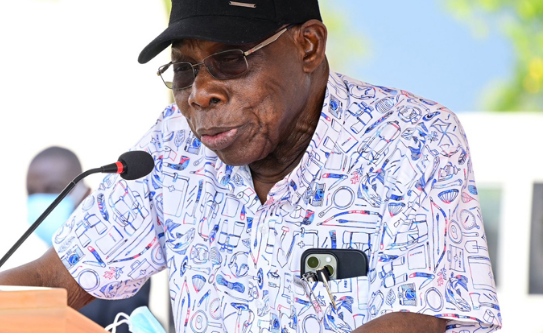
Former President Olusegun Obasanjo, who chaired the dialogue at the Ahmadu Bello International Conference Centre, delivered perhaps the strongest indictment, declaring that Africa had yet to develop a democratic model suited to its realities.
“There is no democracy in Africa but borrowed and forced Liberal Democracy that has caged Africans,” Obasanjo declared while addressing the theme, “Beyond Elections, Can Political Parties and the Judiciary Save African Democracy?”
He argued that Africans inherited Western liberal democracy from their colonial rulers without sufficiently adapting it to the continent’s diverse societies and political realities.
“Since our European Colonial Masters had nothing else to give us, what they are, we swallowed it, lock, stock, and barrel,” he said, challenging Africans to ask whether the inherited system had actually delivered the prosperity, fairness and welfare expected of democracy.
For Obasanjo, democracy should ultimately be measured not merely by elections but by its ability to improve the lives of citizens, protect lives and property, promote inclusion and guarantee a sense of belonging.
“Democracy that works is meant to deliver dividends of democracy in terms of quality of life and living for all the people in a geographical entity, all the nation,” he said.
The former president questioned a system in which electoral victories can allow one side to exercise virtually unchecked power, warning that such an arrangement fails to accommodate Africa’s deep diversity.
He maintained that diversity must be recognised as a central feature of African democracy, particularly in countries such as Nigeria.
“You cannot have a democracy that completely rides roughshod over diversity,” Obasanjo said, stressing that Nigeria’s strength and identity are inseparable from its diversity.
He also questioned the role of the judiciary when the decisions of a handful of judges can overturn the expressed wishes of millions of voters.
His broader argument was that political institutions, parties and the courts must be redesigned or strengthened in ways that produce genuine representation rather than merely reproduce the mechanics of elections.
Former President Goodluck Jonathan, whose foundation organised the dialogue, also called for a review of Africa’s democratic structures, particularly the concentration of political power in the presidency.
Jonathan questioned whether the continent should continue with a model that places enormous authority in the hands of one individual.
“If you look at the structure of government alone, do we really continue with one man having maximum power to cut the yam anyhow he likes?” he asked.
He pointed to Switzerland as an example of a system in which collective decision-making and strong institutions help promote political stability.
Jonathan suggested that African countries could also reconsider elements of the parliamentary system that existed in parts of the continent around independence.
“So, probably the way to go is back to the pre-independence and early independence period of having a parliamentary system where at least the powers are shared,” he said.
According to him, dividing executive responsibilities could prevent the excessive concentration of power associated with the presidential system.
Presidential candidate of the Nigeria Democratic Congress, Peter Obi, joined the criticism, questioning the state of democracy and institutions in Nigeria.
Obi said the country’s judiciary, electoral system, political class and other institutions had undergone a troubling decline.
Recalling his own experience of successfully challenging his election through the courts, he contrasted the judiciary of that period with what he described as the current situation.
“I’m surprised that I have to make remarks, but I have to start by thanking our former President for this consistency in dialogue and discussing democracy. It portrays you as a true democrat,” Obi said.
He expressed concern over what he described as growing electoral malpractice, weakening institutions and the involvement of influential professionals in practices capable of undermining democracy.
“Where will you get that type of judgment in Nigeria today? It is impossible,” he said, recalling how judges he had never met ruled in his favour after years of litigation.
Obi urged Nigerians to reflect deeply on the direction of the country, warning that institutional abuses tolerated today could have serious consequences for future generations.
“It is time for every Nigerian to sit down and ask ourselves, where is our nation going?” he said.
Bayelsa State Governor Duoye Diri brought the debate closer to Nigeria’s federal structure, arguing that democracy cannot flourish without justice, equity and fairness.
He criticised the uneven distribution of resources and development across the country, citing the condition of Oloibiri, the historic oil-producing community in Bayelsa State, as an example of what he described as democratic injustice.
According to Diri, the wealth generated from oil-producing communities has not translated into corresponding development in those areas.
He also questioned the disparity in the number of local government areas among states and argued that the present structure leaves some states at a disadvantage in the distribution of national resources.
“For democracy to thrive in Nigeria, there must be true federalism,” Diri declared.
He warned that without genuine federalism, the country risked continuing to operate a system that was democratic in appearance but weak in substance.
Professor Karuti Kanyinga of the Institute for Development Studies, University of Nairobi, Kenya, warned that African democracy was being weakened from within as ruling and opposition parties increasingly became indistinguishable.
“We have never seen the difference in how they govern,” Kanyinga told delegates.
He argued that the problem went beyond political ideology to include the enormous cost of seeking elective office and the growing influence of private financiers.
Using Nigeria and Kenya as examples, he warned that politicians who depend heavily on private interests to finance campaigns could become vulnerable to policy capture once they attain power.
“The moment you use private businesses to support you, and the moment you win, they capture your policies,” he cautioned.
National Chairman of the Labour Party, Senator Nenadi Usman, meanwhile, urged Nigerian politicians to embrace the peaceful political conduct associated with former President Jonathan.
Speaking on the sidelines of the dialogue, Usman said Jonathan’s decision to concede the 2015 presidential election helped Nigeria avoid the violence and instability many had feared.
She urged politicians preparing for the 2027 elections to respect democratic rules and place the country’s interests above personal ambition.
Usman said Jonathan had consistently maintained that neither winning an election nor remaining in office was worth the blood of any Nigerian — and demonstrated the principle when it mattered most.
The President of the Court of Appeal, Justice Monica Dongban-Mensem, represented at the event by Justice Monsurat Bolaji-Yusuf of the Jos Division, called for closer engagement between political parties and the judiciary.
She stressed that democratic governance depended on strong institutions, constitutionalism, respect for the rule of law, accountability and peaceful resolution of disputes.
“The strength of democratic governance is anchored in strong institutions,” she said.
The dialogue therefore ended with a common thread running through the interventions: Africa’s democratic challenge may no longer be simply about conducting elections, but about building institutions and political systems capable of delivering justice, accountability, stability and development.