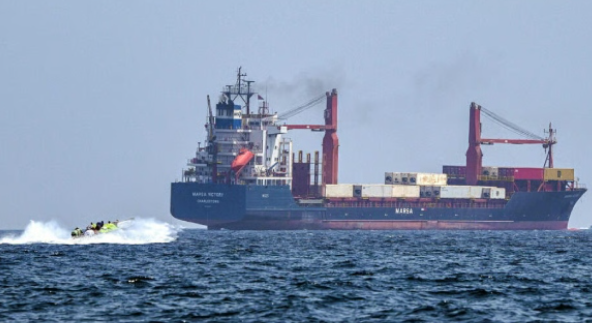
Iran’s military authorities on Saturday announced a renewed closure of the strategic Strait of Hormuz, reversing an earlier reopening and triggering fresh uncertainty across global shipping lanes as vessels scrambled to navigate the volatile situation.
The latest move came just hours after Tehran had declared the waterway open, raising hopes of stability following a temporary ceasefire linked to the wider conflict involving Israel and Iran.
However, those expectations were quickly dashed as the Iranian military signalled a return to tighter control.
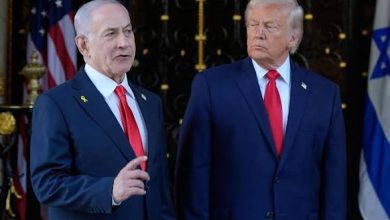
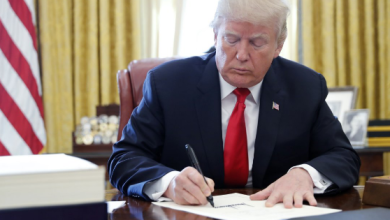
Officials said the decision followed the continued naval blockade imposed by the United States, under President Donald Trump.
The renewed restrictions cast doubt on Trump’s earlier optimism that a peace agreement to end the war was “very close.”
On Friday, Tehran had reopened the strait after a ceasefire arrangement in Lebanon aimed at halting hostilities between Israel and Hezbollah.
The development briefly buoyed global markets, with oil prices falling amid expectations of improved supply flows.
But Washington’s insistence on maintaining its blockade of Iranian ports prompted a swift response.
Tehran warned it would shut the passage again if pressure continued, a threat it appeared to carry out by late Saturday morning.
In a statement, Iran’s central military command said “control of the Strait of Hormuz has returned to its previous status” and that the waterway was now under “strict management and control of the armed forces.”
The announcement coincided with heightened maritime activity.
Tracking data showed several ships rushing through the narrow corridor before restrictions tightened, while others abandoned attempts to exit the Gulf.
By 1030 GMT, at least eight oil and gas tankers had successfully crossed the strait. However, a similar number were seen turning back mid-journey, underscoring the confusion and risk facing commercial shipping.
Tensions escalated further after the United Kingdom Maritime Trade Operations (UKMTO) reported an incident involving a tanker northeast of Oman.
According to the agency, the vessel was approached by two boats linked to Iran’s Revolutionary Guards and came under fire without prior radio communication.
The crew was reported safe, while investigations were ongoing.
Speaking at a diplomatic forum in Turkey, Iranian Deputy Foreign Minister Saeed Khatibzadeh rejected the U.S. strategy, saying the “Americans cannot impose their will over Iran” through what he described as a siege.
Meanwhile, Iran’s Supreme Leader Mojtaba Khamenei, in a written message, declared that the country’s navy “stands ready” to confront the United States, reinforcing Tehran’s defiant posture.
Despite the escalation, diplomatic efforts to end the conflict continue.
With just days left before the expiration of a two-week ceasefire, international mediators have expressed cautious optimism.
President Trump struck an upbeat tone on Friday, describing developments as “GREAT AND BRILLIANT” and praising mediation efforts led by Pakistan.
Islamabad has emerged as a central player in negotiations, hosting initial rounds of talks and pushing for a breakthrough.
Pakistan’s military chief, Asim Munir, concluded a three-day visit to Iran aimed at advancing a deal, while Egypt has also been actively involved.
Egyptian Foreign Minister Badr Abdelatty said both Cairo and Islamabad were hopeful of securing an agreement “in the coming days.”
A second round of negotiations is expected soon in Pakistan’s capital, as diplomats seek to halt a war that erupted on February 28 following coordinated strikes by the United States and Israel on Iranian targets.
Those attacks killed former Supreme Leader Ali Khamenei and several senior officials, sparking a broader regional conflict.
Iran retaliated by targeting U.S. interests in the Gulf, while Hezbollah launched rocket attacks from Lebanon into Israel.
There were, however, tentative signs of stability. Iran’s civil aviation authority announced that its airspace had reopened, allowing international flights to resume transit routes over the eastern part of the country.
Yet key issues remain unresolved, particularly Iran’s stockpile of highly enriched uranium and the long-term status of the Strait of Hormuz.
Speaking by phone, Trump reiterated his confidence, saying “we’re very close to having a deal” and insisting there were “no sticking points at all.”
He also claimed Iran had agreed to surrender roughly 440 kilogrammes of uranium enriched to 60 per cent.
“We’re going to get it by going in with Iran, with lots of excavators,” he said at an event in Arizona.
Iranian officials swiftly pushed back. Foreign ministry spokesman Esmaeil Baqaei told state television that the country’s enriched uranium would not be transferred.
“Iran’s enriched uranium is not going to be transferred anywhere,” he said.
“Transfer of Iran’s enriched uranium to the U.S. has never been raised in negotiations.”
Meanwhile, ordinary Iranians continue to face restrictions at home, with internet monitoring group NetBlocks reporting that a nationwide blackout imposed at the start of the war has now entered its 50th day.
As diplomatic talks continue and military tensions simmer, the situation around the Strait of Hormuz remains a critical flashpoint with far-reaching implications for global energy markets and regional stability.