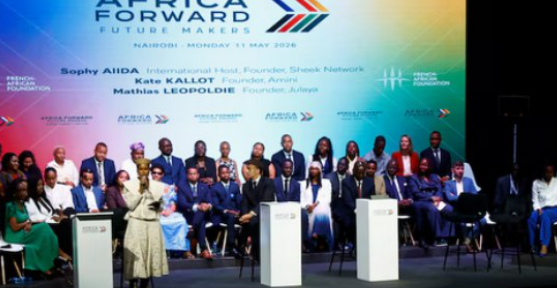
African leaders are set to press for a rethink of how financial risk is assessed on the continent as they gather in Nairobi for a two-day Africa Forward summit with French President Emmanuel Macron.
The meeting, hosted by Kenyan President William Ruto alongside Macron, brings together United Nations Secretary-General António Guterres and delegations from more than 30 African countries, including Nigeria, Senegal, Botswana, Côte d’Ivoire, and Zambia.
The summit is expected to focus on unlocking investment flows into Africa by addressing long-standing concerns over how global financial markets perceive and price risk on the continent.
Kenya’s Foreign Minister, Musalia Mudavadi, said African countries have consistently been treated as high-risk borrowers, a classification that has increased borrowing costs for governments and businesses.
“Africa has always been regarded as a high-risk area. And therefore access to credit, both for governments and for businesses, has always been pegged at higher interest rate,” Mudavadi said.
He added that the continent must push for a fairer global financial assessment system that reflects changing realities rather than outdated perceptions.
“We need to address that. We need to have a situation where the financial markets globally start looking at Africa differently,” he said.
Mudavadi noted that global conflicts showed that risk is not unique to Africa and argued that the continent should not be disproportionately penalised.
He said the ongoing discussions aimed to correct long-held assumptions about Africa’s investment environment, stressing that conflict risk has often been used as justification for higher borrowing costs.
“Conflict risk was the excuse that was always bandied about Africa. But now it is clear that we have to have a relook at how we assess Africa,” he added.
Mudavadi said participation by global financial institutions, including the African Development Bank and the European Bank for Reconstruction and Development, would support efforts to improve financing frameworks for Africa.
He added that improved dialogue between African governments and global lenders could help unlock investment, create jobs and strengthen economic growth across the continent.
African leaders have long criticised global credit rating agencies such as S&P Global Ratings, Moody’s and Fitch for allegedly overstating risks in Africa, a claim the agencies deny, insisting their assessments are based on global standards.
The African Union is also working on establishing a continental credit rating agency to provide what it describes as a more balanced evaluation of African economies.
Supporters of the initiative said it would help reduce borrowing costs and attract more investment into key sectors across the continent.
The African Export-Import Bank recently cut ties with Fitch, citing concerns over its risk assessment methodology.