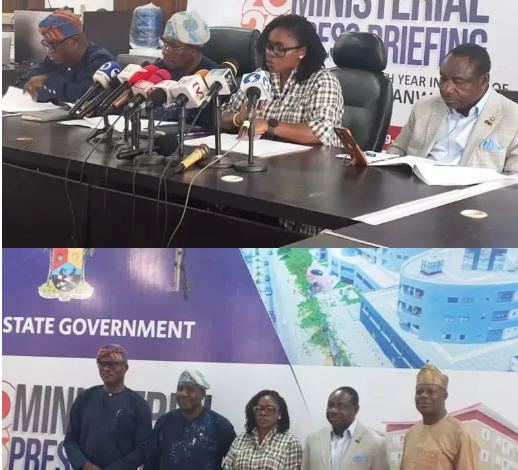
The Lagos State Government has announced plans to launch the first phase of its Central Food Security Systems and Logistics Hub before the end of 2026, in a move aimed at strengthening food supply chains and improving agricultural distribution across the state.
The Commissioner for Agriculture and Food Systems, Ms Abisola Olusanya, made this known on Friday in Lagos during the ministry’s annual ministerial press briefing.
Olusanya said the project represents part of the state’s broader strategy to transform agriculture from a traditional production-focused sector into a modern, integrated food systems economy.
According to her, the administration of Governor Babajide Sanwo-Olu is adopting a holistic approach to food security that covers production, transportation, storage, processing, marketing and household access to affordable and nutritious food.
“Food security goes beyond production. It means building a system where food is produced efficiently, transported safely, stored properly, processed competitively, traded transparently and made accessible to households at stable and affordable prices,” she said.
She explained that the state is investing heavily in infrastructure development, improving market systems, expanding rural road connectivity and supporting youth participation in agribusiness.
Olusanya listed key priorities of the ministry to include the commissioning of the food security and logistics hub, expansion of mid-level food hubs, and scaling up of the Produce for Lagos Programme.
Other ongoing initiatives, she said, include the activation of a N500 billion Offtake Guarantee Fund, implementation of priority rural road projects under the Rural Access and Agricultural Marketing Project, completion of the Lagos Aquaculture Centre of Excellence, and expansion of youth-led agribusiness schemes.
She added that the government remains committed to ensuring food availability, affordability, safety and nutrition while creating jobs and attracting private investment into the agricultural sector.
The commissioner said Lagos’ food strategy is built on four pillars: strengthening domestic production, deepening partnerships with food-producing states, developing storage and logistics infrastructure, and modernising market systems for efficient distribution.
Olusanya also highlighted investment opportunities available in aquaculture, poultry, livestock, rice production, coconut farming, horticulture, feed production, processing, packaging, cold chain logistics, mechanisation, greenhouse farming, digital agriculture and food retail.
“Lagos remains one of the strongest agribusiness investment destinations in Africa, with the population, market size, infrastructure and policy support needed to sustain large-scale food systems investment,” she said.
She called on private sector players, financial institutions, development partners, technology providers and logistics companies to collaborate with the state government.
“The opportunity is clear, the market is ready, the structure is being built and the demand is guaranteed,” she added.