Nigeria’s leading Deposit Money Banks (DMBs) recorded a combined N4.6 trillion in interest income in the first quarter of 2026, reflecting continued strength in earnings despite persistent macroeconomic headwinds and evolving monetary policy conditions.
The figure represented an 8.2 per cent increase compared to the N4.3 trillion reported in the corresponding period of 2025, according to an analysis of unaudited financial statements released by the lenders.
The performance was driven largely by income generated from loans and advances to customers, investments in government securities, balances held with other banks, and other interest-earning assets, even as the Central Bank of Nigeria (CBN) moderated its benchmark rate during the period.
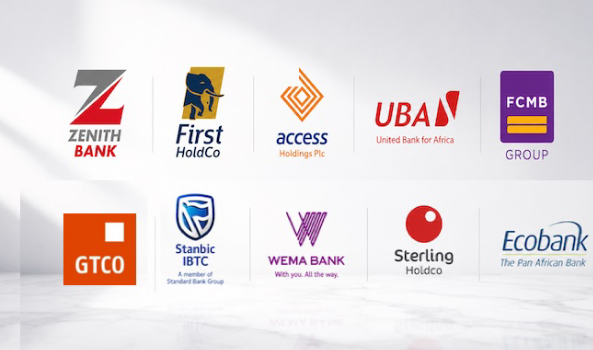
The banks covered in the review included Access Holdings Plc, Zenith Bank Plc, United Bank for Africa (UBA) Plc, Guaranty Trust Holding Company (GTCO) Plc, Ecobank Transnational Incorporated, First Holdco Plc, Wema Bank Plc, Sterling Financial Holdings Company Plc, and Stanbic IBTC Holdings Plc.
The strong earnings came despite a marginal reduction in the Monetary Policy Rate (MPR) from 27 per cent to 26.50 per cent between January and March 2026, amid relative exchange rate stability and easing inflationary pressures.
Among the institutions, Access Holdings, Zenith Bank, and First Holdco led the industry in interest income generation during the period under review.
Access Holdings posted N824.75 billion in interest income, although this reflected a decline compared to the corresponding quarter of 2025.
Zenith Bank reported N869.1 billion, marking a 3.8 per cent increase from N837.64 billion recorded in the same period last year.
First Holdco posted N704.45 billion, representing a 12.7 per cent rise from N625.28 billion in the first quarter of 2025.
UBA recorded N641.1 billion in interest income, up 6.8 per cent year-on-year, while Ecobank posted N561.08 billion, a sharp 23.4 per cent increase from N454.63 billion in the prior year period.
GTCO also maintained strong performance momentum with N466.5 billion in interest income, reflecting nearly 18 per cent growth year-on-year.
The banks’ earnings growth came against the backdrop of persistently high lending rates across the Nigerian financial system.
Data from the Central Bank of Nigeria showed that the average maximum lending rate remained at 35.17 per cent in March 2026, despite the slight easing in the policy rate.
The level remained among the highest recorded in recent years.
Similarly, the average prime lending rate held steady at 19.29 per cent for two consecutive months in March 2026, after peaking at 19.54 per cent in January.
While prime lending rates apply to the most creditworthy borrowers, maximum lending rates represent the upper limit banks can charge customers for loans.
Explaining the policy stance, CBN Governor Olayemi Cardoso said the Monetary Policy Committee, at its 305th meeting, opted to maintain key monetary parameters to allow earlier tightening measures filter through the economy.
He noted that the committee acknowledged a slight uptick in inflation but attributed it largely to temporary external shocks rather than structural pressures.
“The committee’s decisions were anchored on a comprehensive assessment of risks to the outlook,” Cardoso said, expressing confidence that the current policy framework would support gradual disinflation.
Analysts linked the strong interest income performance to Nigeria’s elevated interest rate environment and continued demand for government securities.
Fitch Ratings observed that the CBN’s tight monetary stance remained essential for managing inflation and stabilising the macroeconomic environment.
However, the agency cautioned that despite tightening measures, rapid credit growth and expanding money supply suggested lingering liquidity pressures, with real interest rates still negative and limiting foreign portfolio inflows.
Speaking on the development, investment banker and stockbroker Tajudeen Olayinka attributed the banks’ performance to high lending rates and securities repricing across financial markets.
He said the policy environment was partly aimed at attracting foreign portfolio inflows, strengthening external reserves, and supporting the naira.
Olayinka, however, warned that sustaining such high interest rates could become increasingly difficult due to rising debt servicing costs and broader inflationary pressures on the economy.
“The huge debt service burden on the government and the pressure it exerts on inflation may ultimately raise sustainability concerns,” he noted.