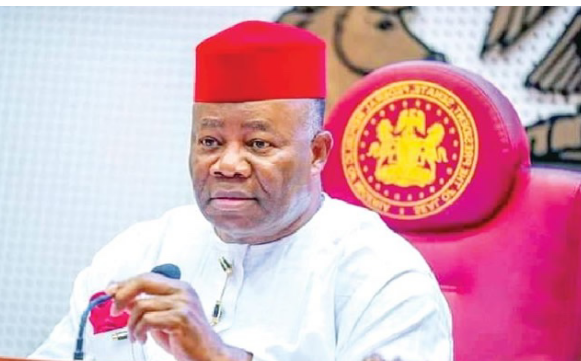
Three years after Senator Godswill Akpabio assumed office as President of Nigeria’s 10th Senate, supporters of the National Assembly leadership say the upper chamber has emerged as a more active, stable and reform-driven institution, playing a significant role in shaping governance during a period of economic and political transition.
When the 10th Senate was inaugurated in June 2023, Nigeria faced mounting economic pressures, security concerns and increasing public demands for effective governance.
Expectations were high that the legislature would not only make laws but also strengthen oversight, support national development and reinforce democratic institutions.
Since then, the Senate under Akpabio’s leadership has pursued an ambitious legislative agenda while seeking to maintain institutional stability and bipartisan cooperation.
One of the most notable achievements of the Senate has been its legislative output.
According to figures released by Senate Leader Opeyemi Bamidele in the chamber’s midterm assessment, the Senate introduced 983 bills and passed 108 between June 2023 and June 2025.
Of these, 83 bills were passed during the 2024/2025 legislative year alone, a figure supporters say reflects a significant increase in legislative activity compared to previous assemblies.
Beyond the numbers, the Senate has focused on legislation aimed at addressing Nigeria’s economic and governance challenges.
Key areas of attention have included tax reforms, public finance management, education, agriculture, energy development and institutional strengthening.
Among the chamber’s most significant legislative interventions were the tax reform bills passed in May 2025.
The measures were designed to simplify tax administration, expand the tax base, improve compliance through digital systems and provide relief for small businesses and low-income earners.
Advocates of the reforms argue that they could substantially improve government revenue generation and reduce Nigeria’s long-standing dependence on oil earnings.
Fiscal experts have projected that the reforms could raise the country’s tax-to-GDP ratio from about 10 per cent in 2023 to approximately 18 per cent by 2027.
The Senate also advanced legislation aimed at expanding access to education and improving critical infrastructure.
The Student Loan (Access to Higher Education) Act, 2024, opened opportunities for students seeking financial assistance for tertiary education, while amendments to electricity legislation sought to encourage greater participation by states and private investors in power generation and distribution.
Electoral reforms also featured prominently on the Senate’s agenda.
Lawmakers pursued amendments intended to strengthen internal party democracy, clarify procedures for party primaries and improve transparency in candidate selection processes.
Additional proposals, including provisions for diaspora voting and early voting for security personnel, remain under consideration.
Unlike previous assemblies often marked by leadership disputes and partisan confrontations, the 10th Senate has largely maintained operational cohesion.
Akpabio’s leadership style has been widely described as consultative, with emphasis placed on consensus-building across party lines.
The Senate comprises members from multiple political parties, including the APC, PDP, Labour Party, NNPP and SDP, yet major legislative business has largely proceeded without prolonged institutional conflicts.
Another notable achievement has been the timely passage of national budgets.
For three consecutive fiscal years, the National Assembly approved federal budgets before the commencement of the new financial year, a development viewed by many analysts as crucial for improving planning, implementation and investor confidence.
The Senate also continued its constitutional oversight functions through investigative hearings, committee reviews and ministerial screenings.
During periods of fuel scarcity, lawmakers engaged stakeholders in the petroleum sector and conducted oversight visits aimed at addressing supply challenges and supporting domestic refining efforts.
On the international stage, the Senate expanded Nigeria’s parliamentary engagement through active participation in global legislative forums. Nigeria secured election to the Executive Committee of the Inter-Parliamentary Union (IPU), marking a significant diplomatic milestone and enhancing the country’s visibility within international parliamentary circles.
One of the Senate’s most consequential interventions came during the political crisis in Niger Republic following the 2023 military coup.
When requests were made for legislative backing of possible regional military action, the Senate advocated diplomatic engagement and restraint, a position that many analysts viewed as an affirmation of legislative independence and constitutional responsibility.
Despite these accomplishments, critics have raised concerns about certain aspects of the Senate’s performance.
Questions have occasionally been asked about the level of scrutiny applied during the confirmation of some executive appointments, while some oversight investigations were criticised for failing to produce stronger outcomes.
Nevertheless, supporters maintain that the Senate’s record reflects a legislature focused on national development and institutional stability.
They point to landmark measures such as the National Minimum Wage Amendment Act, the Investments and Securities Act and various regional development commission laws as evidence of substantive legislative progress.
As the Senate enters its final year before political activities ahead of the next election cycle intensify, attention is expected to shift from legislative productivity to the implementation and impact of the reforms already enacted.
Analysts note that the ultimate assessment of the 10th Senate will depend largely on whether its policies deliver measurable improvements in revenue generation, educational access, infrastructure development and governance outcomes.
For supporters of Senate President Akpabio, however, the first three years of the 10th Senate represent a period of legislative activism, institutional stability and sustained efforts to strengthen Nigeria’s democratic governance framework during a critical phase of national development.
Observers have also pointed to the Senate’s relative political stability as one of the defining characteristics of the current legislature.
Hon. Eseme Eyiboh, former member and spokesperson of the House of Representatives and current Special Adviser on Media/Publicity to the President of the 10th Senate.s