Nigeria and Cameroon have strengthened their defence relations with the signing of a Memorandum of Understanding (MoU) aimed at improving security along their shared southern border and enhancing regional stability amid growing security concerns.
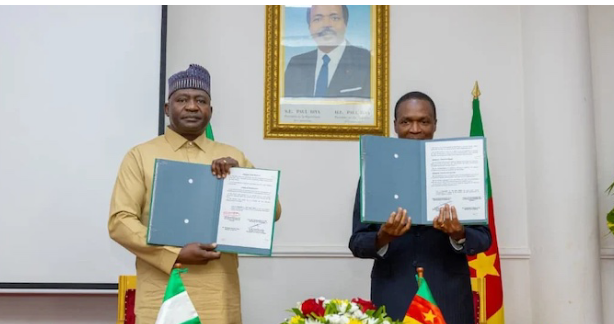
The agreement was signed on Tuesday in Yaoundé by Nigeria’s Minister of Defence, Christopher Gwabin Musa, and Cameroon’s Minister Delegate at the Presidency in charge of Defence, Joseph Beti Assomo.
The deal followed two days of high-level discussions between defence and security experts from both countries, focusing on strengthening cooperation across land and maritime security domains.
According to a statement by the Special Adviser to the Minister of Defence on Media, Leah Katung-Babatunde, the MoU provides a renewed framework for addressing emerging security threats and reinforcing decades-long military collaboration between both nations.
The agreement outlines improved coordination in border security operations, intelligence sharing, logistics support, joint training exercises and personnel exchange programmes aimed at enhancing operational effectiveness.
Officials from both countries also agreed on the need to strengthen joint responses to evolving security challenges along their common frontier.
Speaking at the signing ceremony, Musa said the MoU would institutionalise defence cooperation and provide a structured mechanism for joint operations between Nigeria and Cameroon.
He added that the agreement would also deepen collaboration in addressing shared threats affecting border communities and regional stability.
A key highlight of the discussions was the proposed activation of a Combined Maritime Joint Task Force designed to improve surveillance and security operations in the Gulf of Guinea, a strategic maritime corridor for both countries.
The initiative is expected to enhance protection of economic assets and maritime infrastructure while improving coordinated responses to piracy and other transnational threats in the region.
On defence industrial development, Musa reaffirmed Nigeria’s commitment to expanding cooperation in military technology, innovation and local production capabilities.
He noted that limited indigenous defence manufacturing remains a major challenge across Africa and called for stronger regional partnerships to address the gap.
The minister referenced opportunities under the Defence Industries Corporation of Nigeria framework, stating that Nigeria is open to collaboration in defence production, research, technology transfer and capacity building.
In response, Assomo expressed Cameroon’s readiness to deepen cooperation in defence innovation and confirmed that a formal proposal framework is being developed to translate discussions into concrete bilateral agreements.
He stressed the importance of sustained partnership in advancing regional security and technological development in the defence sector.
The agreement is seen as a major step forward in Nigeria–Cameroon relations, reinforcing commitments to peace, border security and collective defence in response to emerging regional threats.
It also reflects both countries’ shared interest in strengthening cooperation to safeguard sovereignty and promote long-term stability across their common border regions.