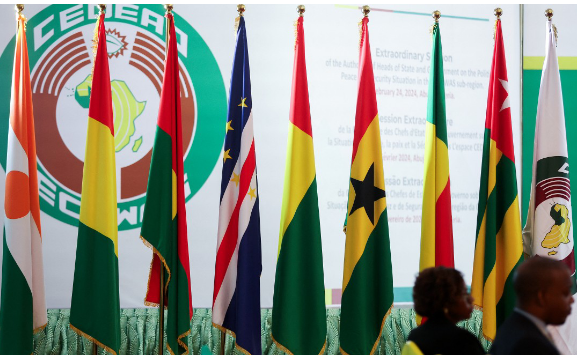
The Economic Community of West African States (ECOWAS) on Thursday inaugurated its new permanent headquarters in Abuja, a landmark facility leaders say represents regional unity, institutional renewal and stronger strategic cooperation between West Africa and China.
The commissioning ceremony drew senior government officials, diplomats and regional stakeholders, with Vice President Kashim Shettima representing President Bola Tinubu, alongside ECOWAS Commission President Dr. Omar Alieu Touray and China’s Ambassador to Nigeria and ECOWAS, Yu Dunhai.
The complex, financed by the People’s Republic of China, was described by speakers as more than an administrative structure, but a symbol of shared commitment to peace, integration and economic transformation across West Africa.
Touray described the inauguration as a “historic milestone” in ECOWAS’ development, noting that it fulfils a vision initiated at the project’s groundbreaking in December 2022.
He expressed appreciation to Chinese President Xi Jinping for supporting the project, saying China had demonstrated consistent commitment to regional development through infrastructure support and broader cooperation initiatives.
The ECOWAS Commission President also acknowledged Nigeria’s role as host nation, citing its provision of land and institutional backing that enabled the project’s completion.
According to him, the new headquarters will resolve long-standing operational inefficiencies caused by the Commission’s previous spread across multiple office locations in Abuja, while improving coordination and productivity.
The facility features a nine-storey central tower with two seven-storey wings, alongside conference halls with interpretation systems, a clinic, banking facilities, restaurants, a gym, shops and a daycare centre.
Touray, however, stressed that infrastructure alone would not guarantee progress, urging member states to ensure the institution becomes a centre of excellence that delivers real benefits to citizens across the region.
“Buildings do not deliver transformation; people and institutions do,” he said.
Representing Chinese President Xi Jinping, Ambassador Yu Dunhai described the headquarters as the “Eye of West Africa,” and a flagship project under the Forum on China-Africa Cooperation (FOCAC).
He said China remained committed to supporting ECOWAS in promoting regional peace, economic growth and improved living standards through cooperation in infrastructure, trade, agriculture, digital economy and investment.
Yu also pledged continued implementation of China’s zero-tariff policy for eligible African exports and called for stronger collaboration in education, culture, youth development and sports.
He reaffirmed China’s position as a reliable partner to ECOWAS and West Africa.
Delivering President Tinubu’s message, Vice President Shettima described the commissioning as both a physical inauguration and a renewal of ECOWAS’ founding ideals of solidarity, integration and shared prosperity.
He commended the ECOWAS Commission and thanked China for financing the project, describing the country as a dependable development partner whose experience offers lessons for Africa’s growth.
Shettima noted that despite progress in regional cooperation, West Africa continues to face serious challenges including terrorism, violent extremism, food insecurity, climate change, unemployment and economic vulnerability.
He urged member states to deepen industrialisation, expand intra-regional trade and strengthen regional value chains to transform West Africa into a production-driven economy rather than one dependent on imports.
“Our integration must increasingly be driven by what we produce rather than by what we consume,” he said, warning that overdependence on imports could undermine economic independence.
He also called for stronger political cooperation and security collaboration among member states, while expressing hope that the new headquarters would serve as a hub for innovation, leadership and collective decision-making across the region.