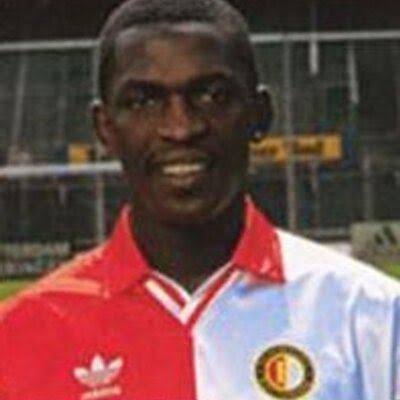
Former Super Eagles striker Michael Edirin Obiku remains one of Nigeria’s most admired football exports, earning widespread acclaim for a career that saw him excel across Africa, Europe and Asia while leaving an enduring legacy in the game.
Born on September 24, 1968, in Warri, Delta State, Obiku rose from humble beginnings to become one of the country’s most prolific forwards.
Renowned for his physical strength, intelligent positioning, clinical finishing and trademark goal celebrations, he built a reputation as a dependable striker wherever he played.
Obiku began his football career with NPA Warri before featuring for Flash Flamingoes and Iwuanyanwu Nationale, now Heartland FC.
His outstanding performances in the Nigerian league paved the way for a move abroad, where he established himself as one of Nigeria’s successful football ambassadors.
During his professional career, he played for Anorthosis Famagusta in Cyprus, Dutch giants Feyenoord and AZ Alkmaar, Helsingborg in Sweden, Spanish side Mallorca and Japan’s Avispa Fukuoka, becoming one of the first Nigerian footballers to feature in the J1 League.
Across spells in different countries, Obiku scored more than 140 career goals, cementing his place among Nigeria’s finest strikers of his generation.
His trophy-laden career included winning the Dutch Eredivisie title with Feyenoord during the 1992/93 season, lifting the KNVB Cup twice in 1993/94 and 1994/95, and capturing the Cypriot First Division title with Anorthosis Famagusta.
At Anorthosis, Obiku became a club legend, earning the nickname “Black Diamond” from supporters in recognition of his match-winning displays, spectacular goals and invaluable contributions.
The nickname remains synonymous with his remarkable impact on the Cypriot club.
On the international stage, Obiku proudly represented Nigeria, featuring in the Super Eagles squad that finished runners-up at the 1988 Africa Cup of Nations.
He also represented the country at the 1988 Seoul Olympic Games, further showcasing Nigerian football on the global stage.
Beyond his achievements as a player, Obiku has remained committed to football development. After retirement, he obtained UEFA coaching qualifications and has devoted time to mentoring young talents through coaching roles and youth development initiatives, including the Feyenoord Soccer Schools.
His continued involvement in grassroots football reflects his desire to nurture future generations and contribute to the growth of the game.
From the football fields of Warri to championship-winning success in Europe and Asia, Michael Obiku’s journey stands as a testament to resilience, discipline and excellence.
His achievements continue to inspire aspiring footballers, while his contributions to Nigerian football have secured his place among the country’s respected sporting icons.