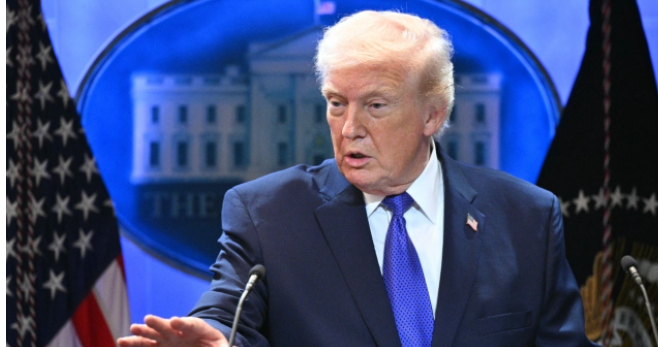
Donald Trump is a deeply unpopular American president, regarded by many as one of the most unpopular presidents in the last hundred years of American history.
His actions have damaged America’s standing in the world and significantly reduced its influence in global affairs and the world economy.
His supposed recent letter to Bola Tinubu, the equally unpopular Nigerian president, is not an American endorsement of Tinubu’s rule in Nigeria.
Rather, it is the outcome of many months of intensive lobbying of the American presidency to secure some level of tolerance for what critics describe as the massive criminality taking place in Nigeria.
The letter issued by the President of the United States, Donald Trump, therefore does not offer a reprieve for Bola Tinubu.
Instead, it appears intended to project an image of tolerance toward the actions of Tinubu by the influential American government, allegedly for the purpose of influencing the coming elections in Tinubu’s favour.
If correctly represented, the letter may simply be the culmination of many months of expensive lobbying by Tinubu’s paid lobbyists.
However, it does not fundamentally change American policy toward the Tinubu government, nor does it affect the various investigations and actions reportedly taking place in the U.S. Congress concerning Bola Tinubu and his administration.
The U.S. government is well informed about the deep-seated problems, alleged criminalities, and disruptions taking place in Nigeria, including the government’s alleged complicity in the insecurity and instability tormenting the nation.
It also possesses records of, and remains mindful of, allegations and legal issues involving Bola Tinubu and several members of his government in both the United States and Nigeria.
Donald Trump, as a member of the conservative Republican Party, may overlook such infractions by a foreign government when it serves strategic interests and could use such matters as leverage to extract concessions from the Nigerian government.
The U.S. government has more information and intelligence about developments in Nigeria than most Nigerian citizens have access to about their own country.
Therefore, no one should make too much of President Trump’s letter to Bola Tinubu.
Expectations surrounding American intervention to remove the Tinubu government were unrealistic, as though the American government owed Nigeria an obligation to correct its political wrongs and remove a government Nigerians consider bad.
Such expectations reflect a troubling colonial mindset and dependency. Nigerians must accept the responsibility of changing their own government rather than expecting foreign powers to rescue them.
The Nigerian political class and public must build within the nation the critical mass, courage, and sustained commitment required to remove a government they consider unacceptable, regardless of the challenges involved.
It is no longer enough to complain about bad governance. The capacity to challenge and replace ineffective governments must be developed and embedded within our political culture.
Bad governance continues to worsen because citizens tolerate it and allow it to grow into impunity, while politicians exploit divisions and weaknesses within society.
For Nigeria to achieve meaningful economic, social, and political progress, we must develop the ability to confront poor governance without destroying the country in the process.
Bola Tinubu did not win the last presidential election, according to his critics, but Nigerians allowed the judicial process that upheld his victory to stand, and he was subsequently sworn in.
We then installed as president a man whom critics argue did not meet the constitutional requirements for the office. Now, we are suffering the consequences of our collective failure to act.
We now seek foreign assistance to correct the pain of our own political choices.
Donald Trump will not come to save Nigeria from its self-inflicted political crisis. In fact, Donald Trump does not traditionally align himself with those he perceives as weak, and he has no obligation to Nigeria.
Recall the confrontation involving the President of Ukraine, Volodymyr Zelenskyy, at the Oval Office in the White House. Alongside his vice president, JD Vance, President Trump harshly criticised Zelenskyy over his position in the war against Russia.
The world watched the tense exchange at the Oval Office.
Another indication of our sense of helplessness is the belief that nature or providence will fight our battles for us instead of confronting our challenges ourselves.
There have been reports suggesting that some judges involved in the case that resulted in Tinubu becoming president later suffered misfortunes, including blindness and death.
Such reactions reflect a desire for punishment against those perceived to have wronged society.
Instead of taking responsibility for enforcing justice, we sometimes fall back on wishes of revenge. But whatever happens to these judges does not change the fact that Nigerians must live with the consequences of the decisions made.
The same Trump is now praising Ukraine for its military successes against Russia.
Donald Trump does not admire weakness and is unlikely to support an opposition movement in Nigeria that appears unwilling or unable to confront its challenges.
In the 2027 elections, if Nigerians want progress and change, they must be prepared to defend democratic principles and enforce accountability collectively.
Ukraine has taught the world that a nation must first demonstrate courage, determination, and resilience before international support becomes meaningful.
@basilokoh