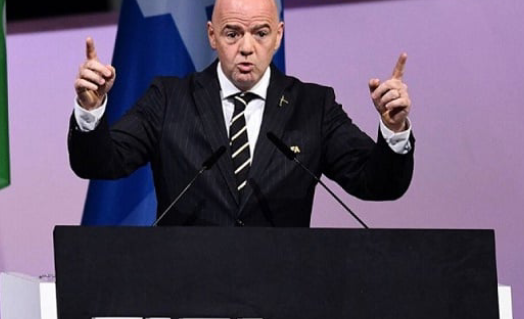
Norway has become the latest football powerhouse to openly challenge Gianni Infantino’s leadership of FIFA, with the country’s football federation declaring that it no longer has confidence in the organisation’s president.
Norwegian Football Federation president Lise Klaveness delivered the blunt assessment after a meeting on Thursday, saying Infantino’s tenure at the head of world football had run its course.
“There is now no trust” in Infantino’s leadership, Klaveness said, adding that his time as FIFA president “should be over.”
The call represents another major setback for Infantino as pressure builds around his administration and its approach to FIFA’s commercial and governance affairs.
At the centre of the latest controversy is the abandoned proposal to bring private investment into FIFA Forward Enterprise.
The planned commercial arm was expected to oversee valuable rights linked to FIFA competitions, including the World Cup.
The proposal triggered resistance from several influential football bodies, with concerns growing over how FIFA intended to structure and manage the new commercial entity.
Although FIFA ultimately withdrew the plan, the decision has done little to calm its critics.
UEFA has maintained its opposition to Infantino and indicated that its threat to boycott FIFA competitions remains unresolved despite the withdrawal of the investment proposal.
The English Football Association has also dealt Infantino another political blow by withdrawing its backing for his bid to secure another term in office at FIFA’s election next March.
But the opposition is far from universal.
Mexico’s football federation has publicly defended Infantino, expressing confidence in his leadership and praising his efforts to expand and develop the game across FIFA’s 211 member associations.
Argentina has also thrown its weight behind the FIFA president. Its football association praised Infantino’s decade at the organisation’s helm, arguing that he has overseen significant changes and introduced what it considers a more transparent governance structure.
South American football’s governing body, CONMEBOL, has meanwhile rejected attempts to accelerate efforts to remove Infantino from office.
The Confederation of African Football has gone further, declaring its “unanimous support” for the FIFA president.
The contrasting positions reveal an increasingly divided football landscape as Infantino approaches another crucial stage of his presidency.
Support from parts of Africa and the Americas provides the FIFA chief with an important political base, while opposition from Norway, UEFA and England highlights the growing resistance within European football.
The dispute also raises broader questions about FIFA’s governance, financial ambitions and decision-making processes.
For Infantino, the challenge is no longer limited to defending one controversial commercial proposal.
He must now confront a widening debate over whether his leadership still commands sufficient confidence among FIFA’s powerful member associations.
With the election approaching, the battle over Infantino’s future could become one of the most significant political contests in international football.