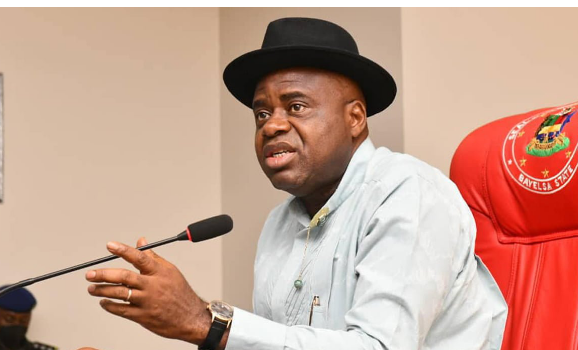
Governor Douye Diri of Bayelsa has warned that Nigeria’s democracy will remain fragile unless the country confronts its deep-rooted problems of injustice, inequality and weak federalism.
Diri made the submission on Tuesday while delivering a goodwill message at the 2026 Goodluck Jonathan Foundation Democracy Dialogue at the International Conference Centre, Bauchi.
Speaking on the theme, “Beyond Elections: Can Political Parties and the Judiciary Save African Democracy?”, the governor argued that democracy could not thrive where citizens and communities felt excluded from the benefits of their resources.
According to Diri, justice, equity and fairness constitute the foundation of a functional democracy, while fiscal federalism and respect for the rule of law are essential to sustaining it.
He said Nigeria had taken a wrong turn in its democratic journey and needed to address structural imbalances that had continued to undermine citizens’ confidence in the system.
Bringing the issue closer to home, Diri cited Bayelsa and the wider Niger Delta as examples of what he described as longstanding injustice in the exploitation and distribution of the country’s natural resources.
He pointed to Oloibiri, where commercial oil production began in Nigeria, arguing that the community and many other oil-producing areas had failed to receive development commensurate with the wealth generated from their resources.
“There is injustice where Oloibiri, the oil community in Bayelsa that made Nigeria a commercial oil producing country, remains a shadow of itself,” Diri said.
The governor also highlighted the situation in Southern Ijaw Local Government Area, an oil-producing area that, according to him, lacked road access for decades despite its contribution to the national economy.
He recalled that his administration recently constructed a 630-metre bridge to provide access to the local government headquarters.
Diri questioned the fairness of a system in which Bayelsa, with only eight local government areas, contributes resources to a national pool from which funds are distributed to states with significantly more local government areas.
“Also, to my mind, there is total injustice where my state has just eight local government areas. Some other states have 40 or more. But, the resources from my state are shared to those local government areas from my eight,” he said.
He argued that changing political leadership alone would not resolve the problem unless the underlying structure was addressed.
“No matter who becomes president, this injustice and unfairness continue. Resources are being expropriated,” the governor stated.
The Bayelsa governor further drew a connection between natural resources and insecurity, pointing to gold-producing areas in northern Nigeria.
“Today, there is gold in Zamfara and other northern states. And what do we experience? Insecurity,” he said, arguing that resource exploitation without an equitable governance framework could contribute to instability.
For Diri, the solution lies in restructuring the relationship between the federal government, states and their resources through genuine federalism.
“So, my dear leaders, my conclusion is that for democracy to thrive in Nigeria, there must be true federalism,” he declared.
He warned that without such reforms, Nigeria risked continuing to operate systems that may appear democratic but fail to reflect the principles of democratic governance.
“Until we begin to practice federalism, we will have some pseudo-democratic, pseudo-autocratic, and sometimes even a tyrannical government in this country,” Diri said.
Diri commended former President Goodluck Jonathan and the Goodluck Jonathan Foundation for sustaining the annual democracy dialogue, describing such platforms as necessary for frank conversations about Nigeria’s political future.
He urged leaders and stakeholders to continue engaging in constructive dialogue rather than allowing political differences to deepen the country’s divisions.
“We must continue to jaw-jaw, so that at the end of the day the country will be better for us all,” he said.
The event, organised in collaboration with the Bauchi State Government, was chaired by former President Olusegun Obasanjo.
Among the dignitaries were former President Goodluck Jonathan and his wife, Dame Patience Jonathan; former Vice President Namadi Sambo; Bauchi State Governor, Senator Bala Mohammed; former Senate President and former Secretary to the Government of the Federation, Anyim Pius Anyim; and presidential candidate of the Nigeria Democratic Congress and former Anambra State Governor, Peter Obi.
The gathering brought together political leaders, legal practitioners, academics and other stakeholders to examine the future of democracy in Africa, with particular attention to elections, political parties, the judiciary and the institutional reforms needed to make governance more accountable and responsive.