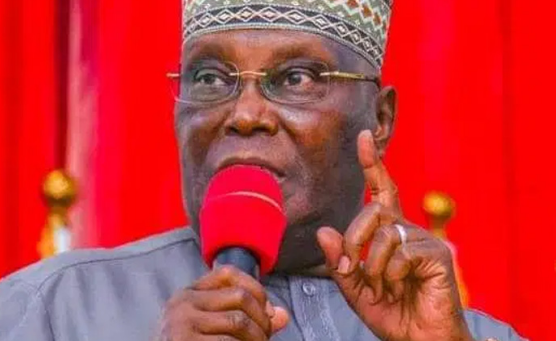
Former Vice President and African Democratic Congress (ADC) presidential candidate, Atiku Abubakar, has criticised the Federal Government over reports that schools in about 40 local government areas have been shut because of insecurity, describing the development as a serious failure to protect Nigerian children.
In a statement issued by his Senior Special Assistant on Public Communication, Phrank Shaibu, Atiku questioned the effectiveness of the N144.86 billion National Plan on Financing Safe Schools for 2023–2026, asking why schools targeted by the programme were still being forced to close because of attacks by terrorists, bandits and other armed groups.
He said the situation was particularly troubling given Nigeria’s already severe out-of-school crisis.
“At a time when Nigeria is already battling a severe out-of-school crisis, insecurity is driving even more children from the classroom,” Atiku said.
He argued that government spending could not be considered successful unless children were actually able to attend school without fear.
“The true measure of a Safe Schools programme is whether our children can actually go to school safely. By that elementary test, the present approach is failing,” he said.
The ADC candidate challenged the Tinubu administration to publish a comprehensive account of the Safe Schools programme, including funds mobilised and released, agencies and contractors involved, schools covered, security infrastructure provided and measurable results achieved.
He, however, said transparency over spending alone would not address what he described as the deeper security problem.
Atiku proposed a decentralised, intelligence-driven approach that would place communities at the centre of school protection.
“What Nigeria requires is a completely different security philosophy. Under my administration, school security will not be treated as another Abuja contract-awarding programme,” he said.
He said vulnerable schools would be supported with early-warning and rapid-response mechanisms, while intelligence sharing among communities, schools and security agencies would be strengthened.
According to him, local communities often have information about emerging threats before they reach federal security structures and should therefore become an integral part of the national security architecture.
He also promised greater accountability, saying every naira spent on school security should be linked to identifiable infrastructure, protected schools and responsible security formations.
“Safe Schools will be measured by children in classrooms, not billions in government documents,” Atiku declared.
The former vice president warned that the impact of insecurity on education extends beyond the classroom, saying prolonged school closures expose children to poverty, child labour, early marriage, exploitation and radicalisation.
“Every school that closes creates another opening for poverty, child labour, early marriage, exploitation and radicalisation,” he said.
He added that keeping children out of school could inadvertently increase their vulnerability to the criminal and extremist networks the government is seeking to defeat.
Atiku described the reported situation in Borno State as especially disturbing, citing reports that 36 students and a staff member of Government Day Secondary School, Lassa, in Askira/Uba Local Government Area, were abducted during examinations in late June.
He also referred to reports that 42 pupils remained missing following an attack in Mussa on May 15.
‘This Is a Surrender of State Authority’
Atiku argued that the ability of armed groups to determine whether schools open or close represents a broader challenge to government authority.
“When terrorists can decide whether Nigerian children go to school, they are exercising authority that belongs to the Nigerian state. That is not merely an education crisis. It is a surrender of state authority,” he said.
He challenged President Bola Tinubu to act on reported intelligence about the locations of terrorists and kidnappers by deploying security forces to those areas, rescuing abducted children and bringing their captors to justice.
“Nigerians do not need another assurance that the government knows where the terrorists are. They want to know why the terrorists are still there—and why our children are still with them,” he said.
Atiku stressed that the abducted children should not be reduced to statistics, but viewed as young Nigerians whose education and futures were being disrupted by insecurity.
Atiku said an ADC-led administration would link school security to a wider restructuring of Nigeria’s security system, with greater emphasis on community intelligence and rapid intervention.
“Our alternative is straightforward: secure the communities, empower local intelligence, protect vulnerable schools, respond rapidly to threats, measure results, and account for every naira,” he said.
He also demanded that the Tinubu administration explain why, despite appropriations and public announcements, parents were still being forced to choose between sending their children to school and keeping them safe.
“Budgetary allocations are not achievements. Press conferences do not protect children. The only result that matters is that a Nigerian child can leave home for school and return safely,” Atiku said.
He concluded with a warning that insecurity could undermine efforts to use education as a tool for reducing poverty.
“Nigeria cannot educate its way out of poverty if terrorists are allowed to lock the classroom door.
”Under our government, criminals will not determine when Nigerian schools open. The Nigerian government shall.”