The Federal Government has secured 746 million pounds to modernise the Apapa Port and Tin Can Island Port in Lagos, in a move aimed at boosting efficiency and competitiveness in the maritime sector.
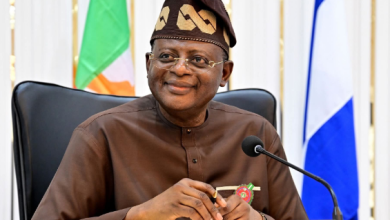
The Minister of Marine and Blue Economy, Adegboyega Oyetola, disclosed this while declaring open the Blue Economy Investment Summit 2026 held in Abuja.
Oyetola said the upgrade project would significantly enhance operational capacity and improve the overall performance of the ports, positioning them to better compete globally.
The summit, organised by the Maritime Innovations Hub in collaboration with the ministry, was themed “Shifting Gears: Heading to the Frontier of the Maritime Economy.”
Highlighting achievements in the sector, the minister noted that agencies under the ministry had recorded substantial growth in revenue generation.
“In 2023 when I assumed office, these agencies generated a total of N700.79 billion. By the end of 2025, this figure had risen substantially to approximately N1.83 trillion.
“This achievement is the result of deliberate and sustained reforms, including strengthened regulatory oversight, improved revenue collection mechanisms and digitalisation of core processes,” he said.
He added that the reforms reflected the government’s commitment to building efficient, accountable and financially sustainable institutions.
Oyetola also emphasised the growing importance of the global blue economy, valued at over three trillion dollars annually, noting that it plays a vital role in trade, climate innovation and sustainable development.
“This presents a remarkable opportunity for Nigeria. Our country is uniquely positioned to harness the vast potential of the marine economy as a cornerstone of national prosperity,” he said.
He cited Nigeria’s extensive coastline, inland waterways and strategic location along the Gulf of Guinea as key advantages.
The minister further revealed that the government had developed and launched a National Policy on Marine and Blue Economy, describing it as a comprehensive framework designed to provide clarity and confidence for investors.
He added that efforts were also underway to revitalise the Regional Maritime Development Bank after more than 16 years of delay, in order to strengthen financing within the sector.
In her remarks, the Chief Executive Officer of the Maritime Innovations Hub, Ronke Kosoko, said the summit was timely, especially given Nigeria’s shift toward a more private sector-driven economy.
She noted that ongoing policy reforms and institutional changes were already attracting investor interest, but stressed that efficiency remained a key requirement for sustained investment.
Also speaking, the Executive Secretary of the Nigerian Shippers Council, Pius Akutah, identified poor logistics and weak maritime connectivity as major constraints to Africa’s trade ambitions.
He urged Nigeria and other African countries to strengthen transport systems to unlock economic potential and enhance intra-African trade.
In a related development, Governor Sheriff Oborevwori of Delta said the state government had set up two committees as part of efforts to establish a ministry dedicated to the blue economy.
Represented by his deputy, Monday Onyeme, the governor said the committees would guide policy formulation and implementation, as well as develop operational frameworks for the sector.
He explained that the initiative aimed to harmonise various blue economy-related policies and programmes across government agencies.
Meanwhile, the Chief Executive Officer of APM Terminals Nigeria, Frederik Klinke, said the current period presents a critical opportunity for Nigeria to reposition its maritime sector for resilience and sustainable growth.
He noted that the global maritime industry is undergoing significant transformation, adding that government support for export growth and digitalisation efforts would be key to future success.