President Donald Trump has renewed threats against Iran, warning that the United States could target the country’s critical infrastructure if ongoing negotiations fail to produce an agreement.
Speaking on Sunday, Trump disclosed that a U.S. delegation would be sent to Pakistan on Monday for fresh talks with Iranian officials.
“NO MORE MR. NICE GUY!” Trump declared in a post, adding that without a deal, Washington was “going to knock out every single Power Plant, and every single Bridge, in Iran.”
The warning comes as Iran, the United States, and Israel approach the end of a fragile two-week ceasefire, which followed a war triggered by U.S.-Israeli strikes on Iran on February 28.
Despite diplomatic efforts, progress has been limited. A 21-hour negotiation session held in Islamabad on April 11 ended without agreement, although backchannel discussions have continued.
“We’re offering a very fair and reasonable DEAL, and I hope they take it,” Trump added.
However, Iranian officials have pushed back, with parliamentary speaker Mohammad Bagher Ghalibaf stating on Saturday that both sides remain “far from the final discussion.”
At the centre of the standoff is Iran’s nuclear programme, which Washington insists must be curtailed to prevent weaponisation—an allegation Tehran has consistently denied.
Trump claimed that Iran had agreed to hand over its stockpile of enriched uranium, estimated at around 440 kilogrammes, but Iranian authorities rejected the assertion.
According to Tehran, the material believed to be buried following earlier U.S. airstrikes, “is not going to be transferred anywhere,” and has never been part of negotiations.
Iranian President Masoud Pezeshkian also questioned why the country should relinquish what he described as its “legal right” to pursue a nuclear programme.
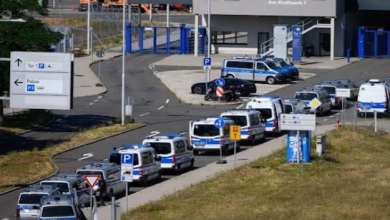
Security was significantly increased on Sunday in Islamabad ahead of the anticipated negotiations.
Authorities imposed road closures and traffic restrictions across the city and neighbouring areas.
Armed personnel and checkpoints were deployed around key locations, including major hotels hosting diplomatic delegations.
Trump said U.S. negotiators would arrive in the Pakistani capital on Monday evening, though he did not disclose their identities.
Previous talks were led by Vice President JD Vance and envoy Steve Witkoff.
Meanwhile, tensions have escalated around the Strait of Hormuz, a crucial route for global oil and gas shipments.
Iran initially closed the strait at the onset of the conflict, disrupting global markets.
Although it briefly reopened the passage following a ceasefire between Israel and Hezbollah, it shut it again after the U.S. maintained its naval blockade on Iranian ports.
Iran’s Revolutionary Guards warned that any unauthorised vessel attempting to pass through would be treated as hostile.
“If America does not lift the blockade, traffic in the Strait of Hormuz will definitely be limited,” Ghalibaf said.
Foreign ministry spokesman Esmaeil Baqaei described the blockade as illegal and a violation of the ceasefire.
Shipping activity in the strait has since dwindled, with reports of vessels being targeted or threatened, underscoring the risks to global energy supply and maritime security.