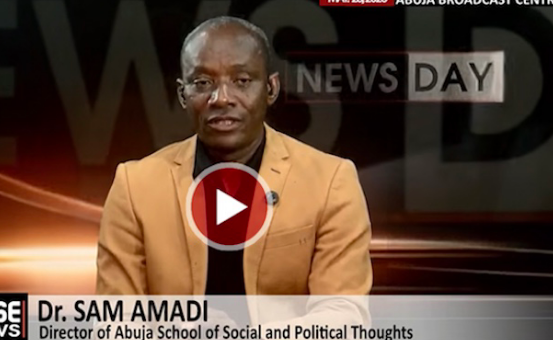
Director of the Abuja School of Social and Political Thought, Sam Amadi, has described the resignation of former Deputy Senate President Ovie Omo-Agege from the All Progressives Congress (APC) as a major political setback for the ruling party in Delta State.
Speaking during an interview on ARISE News on Thursday, Amadi said the development reflects deepening divisions within the APC and could alter the political balance in Delta ahead of future elections.
“Omo-Agege’s exit is a major blow to APC in Delta State,” Amadi stated.
According to him, the resignation did not come as a surprise because recent political developments within the party had gradually weakened Omo-Agege’s position and influence.
“The space seems to be shrinking for leadership for Omo-Agege,” he said.
Amadi explained that tensions involving Omo-Agege, former Delta State Governor Ifeanyi Okowa, and the current political leadership in the state had become increasingly difficult to manage.
“The feud is a strong one,” he added.
The political analyst suggested that Omo-Agege’s defeat in the APC primaries may have contributed significantly to his decision to leave the party.
“It makes sense maybe for him to resign from the party,” he said.
According to Amadi, remaining in the APC would likely have reduced the former deputy senate president to a less influential role within the party structure.
“He’s going to play even less of a secondary role,” he stated.
Amadi argued that Omo-Agege’s departure could strengthen whichever opposition political platform he eventually decides to join ahead of future elections.
“It’s a big loss for the party and a boost to whichever opposition party he supports,” he noted.
He stressed that Omo-Agege remains an influential political figure in Delta State because of the networks and loyal political structures he has built over the years.
“He has his own group in APC,” Amadi said.
The political commentator also maintained that Omo-Agege would remain a formidable contender if he chooses to seek elective office under another political party.
“He’s a strong candidate,” he added.
Amadi further criticised the nature of internal party primaries in Nigeria, arguing that the process is often skewed in favour of candidates backed by incumbent governors and powerful political interests.
“These primaries are not fair,” he stated.
He explained that losing party primaries in such circumstances should not automatically be interpreted as political weakness.
“The governor is in charge,” he said.
According to him, the APC leadership in Delta State may struggle to fully overcome the divisions and grievances created by the internal conflict.
“Something has to give,” he remarked.
Amadi also lamented what he described as the ideological weakness of Nigerian politics, arguing that many politicians are driven more by personal interests than by political principles or party ideology.
“Nigerian politics has become naked self-interest,” he stated.
He warned that similar defections and internal crises could soon emerge in other political parties across the country as politicians intensify their struggle for influence ahead of future elections.
“It’s going to happen in other places,” he said.
According to Amadi, weak conflict resolution mechanisms within political parties continue to fuel instability, disagreements and defections across the political landscape.
“It’s difficult to reconcile these divergent interests,” he stated.
He noted that Omo-Agege’s resignation highlighted broader structural problems within Nigeria’s political system, warning that unresolved leadership rivalries, weak internal democracy and personal political ambitions could continue reshaping political alliances in the years ahead.