The Nigeria Governors’ Forum (NGF) has appealed to President Bola Tinubu to consider raising the national minimum wage from N70,000 to N100,000, citing rising inflation, cost of living pressures and increasing financial strain on workers across the country.
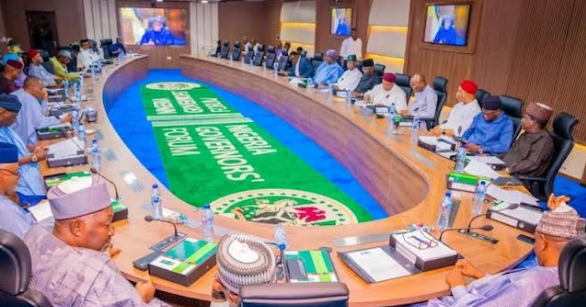
The proposal was made on Friday night during a meeting between the President and state governors at his residence in Lagos, where discussions also centred on economic reforms and the impact of recent policy decisions.
The NGF Chairman and Kwara State Governor, AbdulRahman AbdulRazaq, disclosed the development in a video shared on his Facebook page on Saturday.
According to AbdulRazaq, the call for an upward review of the minimum wage was informed by current economic realities affecting both workers and state governments.
He said governors were actively engaging the Federal Government and organised labour to agree on a wage structure that balances workers’ welfare with the fiscal capacity of states.
“State governments recognise the urgent need to improve workers’ welfare in response to the current economic realities facing Nigerians,” AbdulRazaq said.
“We are actively engaging with the federal government and organised labour to arrive at a wage structure that is fair to workers and sustainable for government finances,” he added.
The NGF chairman explained that the objective of ongoing negotiations is to enhance workers’ purchasing power while ensuring that governments can still fund essential services and development projects.
“The goal is to improve the living conditions of workers while ensuring that states can continue to meet their obligations and sustain development projects that directly impact citizens,” he stated.
AbdulRazaq noted that while state governments are willing to improve wages, they must also consider the financial realities confronting subnational administrations.
He explained that many states are under significant budget pressure after meeting salary obligations, leaving limited funds for other development needs.
“In my own state, when we get the FAAC allocation, after paying salaries, we’re left with N100 or N200 million,” the governor said.
He also claimed that most states have reduced reliance on borrowing and bond issuance for recurrent expenditure, especially salaries.
The NGF chairman also used the opportunity to commend President Tinubu’s decision to remove fuel subsidy, describing it as a bold and difficult reform.
He said governors had initially anticipated widespread protests and had taken precautionary security measures across the states.
“We were expecting serious riots, because there were riots #EndBadGovernance riots even before then and for lesser issues,” he said.
“Well, lo and behold, we spent money and mobilised the security agencies to secure the states.
”Lo and behold, on that day, nothing happened. There were no riots or protests anywhere.”
AbdulRazaq added that the outcome of the policy surprised many political stakeholders and demonstrated the President’s resolve in implementing tough reforms.
“I think the nation was shocked by the audacity of Mr. President to implement that serious policy. Today, we’ve benefited immensely from that policy,” he said.
He further noted that only a small fraction of political leaders could take such far-reaching decisions.
“I can say as a matter of fact, in my own state, when we get the FAAC allocation, after paying salaries, we’re left with N100 or N200 million,” he added.
AbdulRazaq stressed that discussions on the new wage proposal were still ongoing, with emphasis on achieving a balance between workers’ welfare and government sustainability.
“We are actively engaging with the federal government and organised labour to arrive at a wage structure that is fair to workers and sustainable for government finances,” he reiterated.
He said the broader goal is to improve living standards while ensuring that governments at all levels can continue delivering infrastructure and social services.
The current national minimum wage was increased from N30,000 to N70,000 in June 2024 by President Tinubu after signing the relevant legislation into law.
The law also provides for periodic review every three years.
The previous minimum wage of N30,000 was approved in 2019 under former President Muhammadu Buhari.
As discussions continue, stakeholders are expected to weigh the proposal against inflationary trends, state finances and the broader economic outlook.