The Federal Government has unveiled a new National Dairy Policy Implementation Framework aimed at boosting local milk production, strengthening dairy processing, improving cold chain systems, expanding milk aggregation, and promoting pasture development across Nigeria.
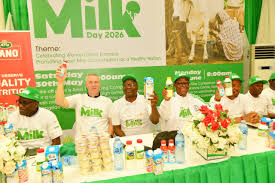
The initiative was announced on Monday in Abuja by the Minister of Livestock Development, Alhaji Idi Maiha, during the 2026 World Milk Day commemoration.
World Milk Day is observed globally every June 1 to highlight the importance of milk and the dairy sector.
The 2026 edition was themed: “Celebrating Women Dairy Farmers: Promoting Fresh Milk Consumption for a Healthy Nation”.
According to Maiha, the framework is designed to support ranch infrastructure, improve animal health services, and encourage stronger private sector participation across the dairy value chain.
He explained that a major milestone in Nigeria’s dairy reform process was achieved in November 2025 when stakeholders were convened to align strategies for improving domestic milk production and development.
The engagement, he said, led to the validation of the National Dairy Policy Implementation Framework, which is expected to translate policy goals into measurable outcomes.
“Nigeria has begun implementing one of the most coordinated livestock and dairy transformation efforts in recent history.
“The establishment of the Ministry of Livestock Development on July 9, 2024, marked the launch of a national roadmap for the livestock sector.
“This bold move has fostered broad-based consensus and inspired the creation of dedicated livestock ministries and agencies in 18 states,” he said.
Maiha disclosed that the government had secured a $2.5 billion investment commitment from Brazilian meat processing firm JBS, which is expected to support the establishment of six processing plants over five years.
He said the facilities would include three poultry plants, two beef plants, and one pork processing plant, all designed to operate with advanced zero-waste technology.
The minister also said the government had completed a nationwide anthrax vaccination campaign, reaching 6.2 million livestock.
“We have profiled more than 600,000 livestock farmers using electronic tools to support collective production and targeted interventions.
“We have also deployed trained livestock extension service providers and private veterinary practitioners to farmer clusters across the country,” he said.
Maiha further revealed that the Nigeria Sovereign Investment Authority had signed a $496 million agreement with Asset Green Limited of the United Kingdom for an integrated dairy production project.
He said the project would feature a 10,000-milking-cow dairy farm, fodder production facilities, and a modern processing plant producing milk, butter, cream, milk powder, and infant formula.
“It is projected to generate about 2,500 direct jobs and more than 5,000 indirect jobs across the dairy value chain.
“These developments signal growing confidence in Nigeria’s dairy economy,” he said.
The minister added that the government was intensifying efforts under the National Livestock Growth Acceleration Strategy to promote dairy industrialisation.
He said the strategy focuses on feed and fodder development, animal health services, cold chain expansion, genetic improvement, dairy hubs, milk collection centres, and climate-smart livestock practices.
Speaking on the theme of the event, Maiha said government policies are deliberately promoting women’s participation in dairy production under the Renewed Hope Agenda of President Bola Tinubu.
He noted that women farmers are being supported with labour-saving tools, improved milk storage systems, mobile veterinary services, and tailored extension programmes.
“Women often shoulder the dual responsibilities of livestock production and household care,” he said.
Maiha stressed that improving women’s productivity in the sector requires sustained investment in infrastructure, training, financing, technology, market access, and social protection.
He also disclosed that capacity-building programmes had been carried out for smallholder dairy farmers in Borno and Oyo States.
“We remain committed to building a dairy sector that is not only productive and commercially viable, but also inclusive, equitable and transformational for women, youth and communities across Nigeria.
“Nigeria’s dairy sector, spanning production, logistics, processing and marketing, is open to investors. The market is vast.
“Within the current Nigerian economy, the production of 1,000 litres of milk daily generates one of the strongest sustainable job-creation profiles.
“Cows must be fed, watered, milked, monitored and treated. Daily milk collection, cold chain operations, transportation, aggregation and marketing all create employment opportunities.
“Producing 1,000 litres of fresh milk daily in Nigeria can support between 35 and 75 full-time jobs across the value chain,” he said.