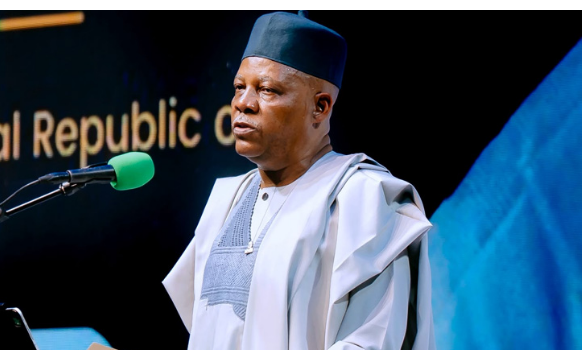
Nigeria has officially moved the World Bank-supported $500 million Sustainable Agricultural Value Chains for Growth Programme (AGROW) into its implementation phase following the submission of the final report of the National Technical Working Group (NTWG) to Vice President Kashim Shettima.
The report presentation at the State House, Abuja, marked the end of the programme’s design stage, which involved extensive consultations with states, agricultural stakeholders and development partners.
Shettima said the initiative would bridge the long-standing gap between Nigerian farmers and the government systems responsible for planning, policy formulation and economic decision-making.
He noted that while farmers who cultivate the land have remained central to the nation’s food production, they have often been disconnected from the policies and structures that determine the value of their labour.
According to him, AGROW was designed to close that gap by creating a programme rooted in the realities of farmers, implemented through states and capable of attracting private sector investment to transform agriculture from subsistence farming into a commercially viable sector.
“Today marks the transition of AGROW from programme design to implementation,” the Vice President said.
The programme was developed through seven zonal consultations involving 32 states, reflecting growing interest among sub-national governments to take greater responsibility for agricultural productivity, infrastructure, extension services and market development.
Shettima stressed that agriculture remains too important to be treated as a marginal sector, noting that it contributes about 23 per cent of Nigeria’s Gross Domestic Product (GDP) and supports 34 per cent of the workforce.
He said improvements in agricultural productivity would have wider economic benefits, including lower food prices, stronger rural incomes, increased industrial raw materials supply, job creation and reduced pressure on foreign reserves.
“When yields rise, food prices ease, rural incomes recover, industries receive raw materials, and pressure on our cities and foreign reserves begins to relax. When yields fall, the entire economy discovers the price of hunger,” he said.
The Vice President disclosed that $355 million, representing 71 per cent of the total $500 million financing package, would be implemented through participating states, placing state governments at the centre of programme delivery.
He, however, acknowledged that the funding alone would not address all the challenges accumulated over decades in areas such as extension services, infrastructure, technology, processing and market access.
Shettima praised members of the National Technical Working Group for producing what he described as an inclusive, evidence-based and technically rigorous framework for agricultural transformation.
He formally accepted the report and approved the dissolution of the working group, saying responsibility for the next stage would now move to the Federal Ministry of Agriculture and Food Security through the National Steering Committee and Project Coordination Office.
The Vice President also commended the Presidential Food Systems Coordinating Unit for coordinating the design process and supporting the technical committee.
Nasarawa State Governor Abdullahi Sule, who spoke on behalf of state governments, assured the Vice President of the commitment of sub-national administrations to the programme.
Sule said governors had been briefed by the World Bank through the Nigeria Governors’ Forum and were ready to maximise the opportunities provided by AGROW.
Similarly, Kaduna State Deputy Governor Hadiza Balarabe said the state would establish a coordination mechanism to support implementation, adding that Kaduna already allocates more than 13 per cent of its budget to agriculture because of the sector’s importance to economic development.
Minister of Finance and Coordinating Minister of the Economy, Taiwo Oyedele, described the submission of the report as a significant step that demonstrated what could be achieved when government agencies, states and development partners work together.
He said AGROW goes beyond food production, describing it as a key component of Nigeria’s economic transformation strategy, job creation efforts and macroeconomic stability.
Minister of Agriculture and Food Security, Senator Abubakar Kyari, praised Shettima’s leadership in coordinating stakeholders during the programme’s design phase.
Kyari said the ministry was committed to ensuring successful implementation of AGROW in line with the Renewed Hope Agenda of the Tinubu administration.
He explained that attention would now shift to completing processes including the borrowing plan, financing agreement and legal requirements needed to move from design to full execution.
World Bank Programme Leader for AGROW, Bertine Kamphuis, reaffirmed the institution’s continued support for Nigeria, expressing confidence that the programme would help improve food security and reduce poverty.
She emphasised the need for stronger private sector participation across the agricultural value chain and highlighted the importance of supportive policies and institutions, including the Bank of Agriculture, in achieving the programme’s objectives.
Technical Adviser to the Vice President on Agriculture and Executive Secretary of the Presidential Food Systems Coordinating Unit, Marion Moon, said the technical group developed an eight-indicator framework to identify priority agricultural value chains based on Nigeria’s different ecological zones, soil conditions and rainfall patterns.
She added that feedback gathered from the seven zonal consultations involving 32 states was incorporated into the final AGROW design.
The presentation of the final report formally concluded the assignment of the National Technical Working Group and opened the way for the implementation of one of Nigeria’s largest agricultural transformation initiatives aimed at improving productivity, investment and food security.