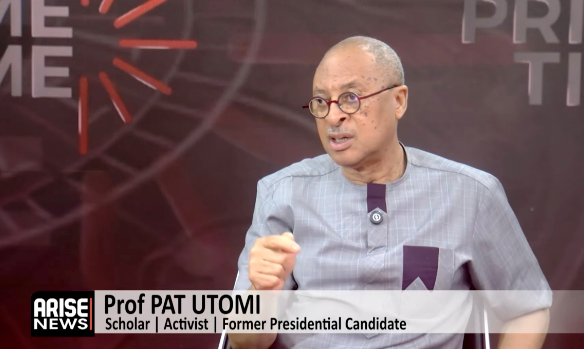
A former presidential candidate and academic, Professor Pat Utomi, has said he was not aware of Peter Obi’s reported move from the African Democratic Congress (ADC) to the Nigeria Democratic Congress (NDC) until he heard about it while outside the country.
Speaking in an interview with ARISE NEWS on Monday, Utomi explained that he had initially pushed for members to remain within the ADC and contest internally rather than defect.
However, he noted that concerns about alleged political interference may have influenced the eventual decision to change course.
“I was out of the country when the move took place. I wasn’t aware of the plans to make the move.
”I had argued very stoutly that everybody should stay where they are, fight to prove a point that this can be won from this platform,” he said.
He added that he was aware of what he described as behind-the-scenes political manoeuvring aimed at excluding certain candidates from the ballot, suggesting that such developments may have pushed the decision for a quick exit from the party structure.
“But I was also quite aware of games that were being played the games of the process to really prevent a certain candidate from being on the ballot.
”A very undemocratic kind of game being played, and they had to play quick to escape being caught in the trap. And perhaps, with the benefit of hindsight, they were wise,” he said.
Utomi also argued that, in hindsight, Obi’s decision to leave the ADC may have been strategic, especially in light of recent internal tensions within the party.
“With the benefit of hindsight, given what we’ve seen that just happened in the ADC with Richmond and others complaining, it was almost like a foregone conclusion that it would go in a particular direction.
”So, it was a pretty smart move on his part,” he maintained.
He also referenced earlier polling data suggesting that Obi could have performed strongly in a transparent primary, but questioned whether the party structure would have allowed a fair contest.
“Even though we had polling that suggested he would defeat the other candidates within ADC. But the problem was not so much whether you had proper direct primaries, but if the main players would allow a proper process,” he said.
According to him, internal democracy across Nigerian political parties has increasingly been undermined by powerful figures who influence candidate selection, reducing primaries to what he described as symbolic exercises.
“Party hierarchies and bosses are more or less imposing people, and they go through these processes as a make-believe of the democratic process,” he said.
On broader political engagement, Utomi said his focus has shifted to the Big Tent initiative, which he described as a platform for developing a national policy framework and supporting candidates across party lines based on competence and credibility.
“What we have done is to continue this process within the Big Tent to do a manifesto for Nigeria and those political actors who have the capacity, the competence, and disposition we will endorse,” he said.
He also criticised what he described as Nigeria’s tendency to sideline capable individuals in favour of entrenched political actors, arguing that experience is often overstated and repeated rather than meaningful.
“That political process is full of people who have one year of experience repeated so many times and they claim they have experience,” he said.
Utomi further called for stronger electoral discipline, urging the Independent National Electoral Commission (INEC) to take a tougher stance on frequent party defections, which he said weaken political accountability.
“Even in this process, we’ve seen characters jump from one party to another… I would like INEC to win and stop all these characters jumping from one party to the other,” he said.
He added that Nigeria’s opposition politics is often weakened by excessive focus on political office, which he believes undermines collective national goals.
“This obsession with power and public office is a disease. Nigerian political actors need to be purged of it,” he said.
In more emotional remarks, Utomi questioned the mindset of some political actors, suggesting that deeper reflection is needed on whether they are truly motivated by national interest.
“We need to bring Nigerian politicians to put them through some kind of psychiatric process. Do they care about their country?” he said.
Despite his criticism, he maintained that Nigeria still has the capacity for reform, pointing to ongoing hardship as a reason for urgent change.
“Nigerians have paid enough, the insecurity, the hunger in the land.
”Despite the behavior of politicians, they may still effect a turnaround of the system,” he said.
On electoral transparency, he clarified that a proposal for live transmission and monitoring of polling unit results originated from the Big Tent initiative and was not initially an NDC policy position, as reported in some media.
“I first saw that in the form that it came out, and attributing that to the NDC… It was not NDC, no, it was the Big Tent,” he said.
He explained that the idea was still being developed as part of a broader system involving multiple independent monitoring groups to strengthen electoral credibility.