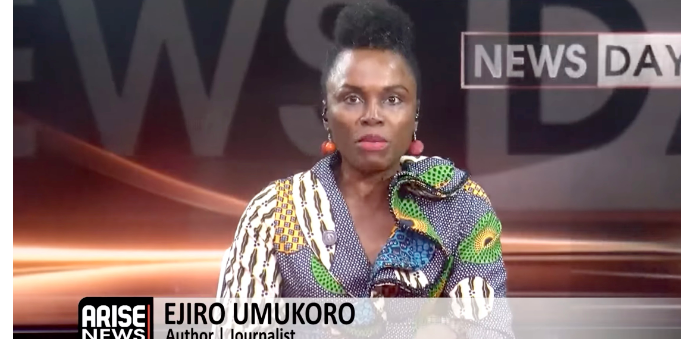
Author and journalist Lady Ejiro Umukoro has urged the Nigerian Educational Research and Development Council to suspend its proposed textbook ranking framework, warning that the initiative could create fresh challenges for publishers, authors and parents across the country.
Speaking during an interview on ARISE Television, Umukoro expressed concern over the proposed policy, arguing that its implementation could place additional financial pressure on an already struggling publishing sector while driving up the cost of educational materials.
“They need to pause this particular exercise they are about to start,” she said.
According to her, the proposed ranking system risks undermining the intellectual contributions of authors and publishers who invest significant resources in producing educational content.
“It is a situation where there is a hijack of the intellectual capacity and capital outflows from publishers and authors alike,” she stated.
Umukoro noted that publishers are already grappling with numerous economic challenges, particularly the rising cost of production.
She pointed to the absence of a functional paper manufacturing industry in the country as one of the major obstacles confronting the sector.
“We do not have one single functional paper mill industry in Nigeria,” she said.
She questioned the rationale behind the fees associated with the proposed assessment process, arguing that the financial demands could threaten the sustainability of publishing businesses.
“Are you trying to make me survive or are you trying to strangle me and make sure I am dead?” she asked.
The author further warned that any additional costs imposed on publishers would inevitably be passed on to consumers, particularly parents who already face increasing education-related expenses.
“The people who are going to suffer the consequences of all of this are parents,” she said.
Umukoro stressed that education policies should prioritise the welfare and development of students rather than creating systems that make learning materials more expensive and less accessible.
“Children are no longer seen as the foundation of a society’s development,” she stated.
She also raised concerns about the transparency of the proposed ranking process, questioning how educational materials would be evaluated and what benchmarks would be used in determining their scores.
“Who decides what is 70 per cent? What are the criteria?” she asked.
The journalist maintained that broader consultations with industry stakeholders should have preceded the introduction of such a framework.
She argued that publishers, authors, educators and other key players deserve an opportunity to contribute to discussions on policies that directly affect the sector.
“We need to have a proper stakeholder meeting,” she said.
Calling for immediate action, Umukoro urged the council to halt implementation plans and engage in meaningful dialogue with stakeholders before proceeding further.
“They should put a halt to it,” she stated.
She further observed that existing curriculum implementation challenges remain unresolved and should be addressed before introducing additional reforms.
“As we speak, the last curriculum implementation has not even been effected,” she said.
Umukoro concluded by reiterating her call for the suspension of the proposed textbook ranking framework, insisting that wider consultations are necessary to ensure that any policy introduced strengthens rather than weakens Nigeria’s education and publishing sectors.
She maintained that without adequate stakeholder engagement and clear evaluation criteria, the framework could increase costs, create uncertainty for publishers and place further financial strain on parents already struggling with the rising cost of education.