India and Nigeria are expanding their strategic partnership across trade, investment, defence, energy, healthcare, agriculture and technology, with bilateral trade rising to about $9 billion in the 2025–26 financial year.
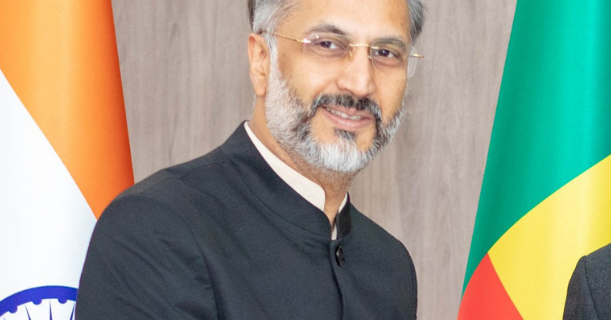
Indian High Commissioner to Nigeria, Abhishek Singh, disclosed this in Abuja during a media briefing on the growing relationship between the two countries and emerging opportunities for deeper economic and strategic cooperation.
The latest figure represents a significant increase from the $7.13 billion recorded in 2024–25, highlighting the growing economic importance of ties between Nigeria, Africa’s largest economy, and India, one of the world’s major emerging powers.
Singh said the relationship had moved well beyond its traditional foundations of historical goodwill and crude oil trade, evolving into a broad partnership covering security, technology, food security, healthcare, agriculture and global governance.
“India-Nigeria relations are no longer defined only by historical goodwill or oil trade, ” he said.
According to the envoy, more than 200 Indian companies currently operate in Nigeria, with investments spanning pharmaceuticals, manufacturing, power, construction, consumer goods, healthcare and services.
He said several of the companies had established manufacturing plants and production facilities locally rather than merely importing goods, collectively generating employment for nearly 100,000 Nigerians.
Singh said the growing presence of Indian businesses reflected investor confidence in Nigeria’s market and long-term economic prospects.
Energy security continues to occupy an important place in the relationship, with crude oil and liquefied natural gas remaining significant components of bilateral trade.
However, Singh said cooperation was expanding into areas including Indian investment in Nigeria’s oil and gas industry, pipeline security, compressed natural gas conversion and liquefied petroleum gas infrastructure.
He noted that the huge populations of both countries created substantial energy requirements.
“This is all the more reason that the two great democracies, India and Nigeria, should cooperate more in the field of energy security, ” he said.
Defence and maritime security, he added, were also important components of the partnership, with cooperation dating back several decades.
Singh recalled India’s role in supporting Nigeria’s establishment of the National Defence Academy in Kaduna and the Naval College in Port Harcourt.
He said both countries face common security threats, including terrorism, violent extremism, piracy, organised crime and illicit trafficking.
Consequently, cooperation has expanded to intelligence sharing, counter-terrorism, defence training and maritime security, particularly around the Gulf of Guinea.
A Nigerian naval delegation, he disclosed, was expected to visit India for bilateral discussions, while defence equipment and sales also remain areas of cooperation.
Singh said India’s development partnership with Nigeria had yielded tangible results, including $395 million in concessional lines of credit.
The Indian government has also provided professional and technical training to Nigerians through the Indian Technical and Economic Cooperation (ITEC) programme.
Beneficiaries have received training in areas such as auditing, teaching, rural development, electrification and other specialised fields, while Nigerian military personnel continue to attend training programmes at Indian defence institutions.
According to Singh, India’s development assistance is designed around areas where Indian expertise can complement Nigeria’s own priorities.
These included affordable medicines, Digital Public Infrastructure, agricultural development, skills acquisition, food security, climate-resilient development and space applications.
Healthcare remains a particularly important area, with India leveraging its strong pharmaceutical manufacturing base.
The envoy said India is widely recognised as a major producer and exporter of medicines and remains one of the leading suppliers of pharmaceutical products to Nigeria.
Singh attributed the recent momentum in bilateral relations partly to increased high-level political engagement.
He recalled President Bola Ahmed Tinubu’s visit to India in September 2023 during India’s G20 presidency, describing it as significant because it coincided with the formal admission of the African Union into the G20.
The engagement was followed by Indian Prime Minister Narendra Modi’s state visit to Nigeria in November 2024, the first visit by an Indian prime minister to Nigeria in about 17 years.
During the visit, Modi and Tinubu discussed trade and investment, defence, energy, agriculture, healthcare, education, technology and security.
Nigeria subsequently conferred one of its highest national honours, the Grand Commander of the Order of the Niger (GCON), on the Indian Prime Minister.
Singh also cited the participation of India’s Defence Minister, Rajnath Singh, at Tinubu’s inauguration in May 2023 and the visit of India’s External Affairs Minister, S. Jaishankar, to Abuja for the Sixth India-Nigeria Joint Commission Meeting in January 2024.
Looking ahead, India is seeking greater Nigerian participation in international economic and political platforms, particularly BRICS.
Singh disclosed that President Tinubu had been invited to the BRICS Leaders’ Summit scheduled for September 12–13, 2026, in New Delhi, expressing hope that the Nigerian leader would attend with a high-powered delegation.
He said Nigeria’s participation would be significant given its position as Africa’s largest economy and one of the world’s most populous countries.
India assumed the BRICS chairmanship in 2026, with the summit expected to focus on global challenges, economic cooperation and engagement with partner countries.
The two countries are also supporting each other’s aspirations at the United Nations.
Singh said Nigeria had conveyed its support for India’s campaign for a non-permanent seat on the UN Security Council, while India had similarly expressed support for Nigeria’s candidacy.
India’s campaign is being promoted under the banner “SHANTI” Securing Holistic Advancement through Norms, Trust and Integrity, reflecting New Delhi’s push for a peaceful, inclusive and reformed global order.
Singh reiterated India’s position that reform of the UN Security Council should include expansion of both permanent and non-permanent membership.
The High Commissioner also highlighted the role of the Indian community in Nigeria, estimating its population at about 60,000.
Many, he said, are second- and third-generation Indians who have become deeply integrated into Nigerian society.
He expressed appreciation to Nigerians and the government for providing the community with opportunities to establish businesses and contribute to national development.
According to Singh, the community serves as an important bridge between the two countries in commerce, education, healthcare and culture.
He noted that many members see India as their motherland while regarding Nigeria as their fatherland.
India’s diplomatic presence in Nigeria dates back to 1958, when it established a Liaison Office in Lagos, two years before Nigeria gained independence.
The relationship was elevated to a Strategic Partnership in October 2007, paving the way for wider political, economic and security cooperation.
Nearly two decades later, Singh said the partnership had developed into a multidimensional relationship with growing implications for both nations and the wider Global South.
With trade approaching $10 billion, more than 200 Indian companies operating in Nigeria, nearly 100,000 Nigerians employed by Indian firms and cooperation spreading across defence, energy, healthcare, agriculture and technology, the Abuja-New Delhi relationship appears set for a deeper phase.
For India, Nigeria is increasingly being viewed not simply as a major African trading partner, but as a strategic partner in shaping the future of Africa, the Global South and an increasingly multipolar international order.